

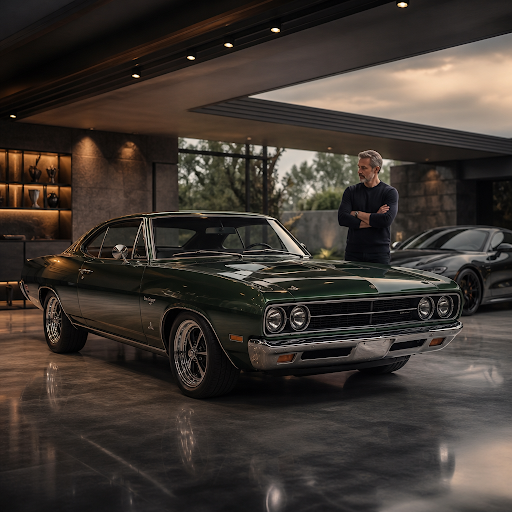
Something odd is happening in American driveways. The daily commuter is getting quieter, heavier and more software-dependent every model year, while the thing parked next to it is getting louder, older and more analogue. Buyers who once would have owned two sensible sedans now own one efficient runabout and one carburetted or fuel-injected relic from the Johnson administration. It is not nostalgia for its own sake. It is a deliberate split: one car for errands, one car for the parts of driving that no spreadsheet can justify.
If you are thinking about joining them, the good news is that the vintage performance market has matured enormously. The bad news is that maturity cuts both ways — the bargains are harder to spot, and the mistakes are more expensive. Here is how to think about it before you start trawling listings at midnight.
The appeal is mechanical honesty, not horsepower
A modern performance car will outrun almost any 1960s muscle car on any surface, in any weather, while playing a podcast. That is not the point. What a well-sorted vintage car offers is unfiltered feedback: a steering wheel that tells you about camber changes, a drivetrain with audible personality, and controls you can understand by looking at them. There is no lag between intention and response because there is almost nothing in between.
That mechanical transparency is also what makes these cars ownable. A competent home mechanic with a socket set, a timing light and a manual can diagnose most faults. Try that with a sealed battery pack or a torque-vectoring module. The repair economy around 1960s American performance cars is deep, the parts supply is extraordinary, and the knowledge is freely shared at every cars-and-coffee in the country.
Where the two-car split actually makes sense
The economics only work if the old car is not doing the heavy lifting. Vintage muscle cars are terrible commuters: drum brakes that fade, no crumple zones, fuel consumption measured in low teens, and a tendency to overheat in stop-start traffic. Pair one with an efficient daily driver and the equation flips. The old car covers a few thousand miles a year at weekends, holds value far better than a depreciating new vehicle, and costs comparatively little to insure on an agreed-value classic policy with mileage limits.
Interestingly, the people most open to a vintage weekend car are often the same people considering an EV for daily duty — and the practical friction that keeps many drivers from making that switch, from charging access to upfront cost, is exactly the sort of trade-off worth weighing before you commit to either half of the garage. Knowing what your weekday car genuinely needs to do makes it far easier to let the weekend car be gloriously impractical.
Buying: what separates a good car from a money pit
Rust is the only number that really matters
Engines can be rebuilt, interiors retrimmed, chrome replated. Structural corrosion is the expense that quietly doubles a restoration budget. On a unibody car from the era, check the torque boxes, floor pans, frame rails, cowl area, shock towers, trunk drop-offs and the lower rear quarters. Bring a magnet and a small flashlight, and get underneath. Fresh undercoating on an otherwise tired car is a warning sign, not a selling point.
Documentation beats paint
A shiny respray hides more sins than it reveals. What you want is a folder: build records, decoded VIN and data plate information, old registrations, receipts for the last decade of work. Matching numbers matter enormously at the top of the market and less in the middle, but provenance always matters. Pay the money for a marque-specific inspection before you wire funds — a few hundred dollars spent on an expert’s eye is the cheapest insurance in this hobby.
Decide which kind of car you actually want
- Concours-correct original: highest ceiling in value, lowest tolerance for miles and modifications. Drive it sparingly.
- Driver-quality survivor: honest paint, period-correct mechanicals, usable on real roads. Usually the best value-per-smile.
- Restomod: vintage body, modern drivetrain, brakes, steering and cooling. Costs more to build than most people expect, but it is the only version you can drive confidently in modern traffic.
- Project car: only sensible if you want the project more than the car. Assume the total spend will exceed the price of a finished example.
The restomod question, and the engine at the centre of it
Purists wince, but the modernised vintage car has become the dominant way people actually use these machines. Disc brakes, rack-and-pinion steering, a modern cooling system, five- or six-speed transmissions and electronic fuel injection turn a nervous Sunday cruiser into something you would happily take across three states. The biggest single decision in that process is what sits between the shock towers, and a well-chosen modern crate engine for a classic car project can transform reliability and driveability without wrecking the character of the car. Choose the supporting hardware — radiator, wiring, fuel delivery, driveshaft, rear end — at the same time; mismatched components cause most restomod disappointments.
Reversibility is worth protecting. Keep the original engine, carburettor, intake and any date-coded parts on a shelf, properly labelled. If you or a future owner ever wants to return the car to stock, those boxes can be worth as much as the modifications.
Where to look when you want a sorted car rather than a story
Not everyone wants to spend four years learning to weld. For buyers who would rather hand over money once and start driving, the market has developed a tier of specialists who build or restore to a known standard, with documented component choices, warranties on their work and the sort of fit-and-finish that is almost impossible to achieve in a home garage. Firms focused specifically on classic mustangs are a useful reference point even if you ultimately buy privately, because their build sheets show you what a genuinely complete car includes — things like modern brake and suspension geometry, properly engineered cooling, serviceable wiring and correct trim details that amateur builds routinely skip. Reading a professional specification teaches you what questions to ask any seller.
Running costs people forget
- Storage: dry, ventilated, ideally with a battery tender and a trickle of airflow. Damp garages destroy cars faster than roads do.
- Tyres: they age out before they wear out. Budget to replace them every six to ten years regardless of tread depth.
- Fluids and fuel: ethanol-blended pump gas attacks old rubber and some fuel tank linings. Modern replacement hoses and seals solve it cheaply.
- Use it: cars that sit develop flat spots, seized calipers, dried seals and stuck rings. Regular short drives are maintenance.
A sensible first year
Resist the urge to tear a running car apart. Spend the first twelve months driving it, keeping a notebook of every noise, leak and hesitation, and sorting the list in order of safety first: brakes, steering, tyres, fuel lines, seatbelts. Then reliability: cooling, charging, ignition. Cosmetics last. Owners who follow that order end up with usable cars. Owners who start with paint end up with a shiny shell on jack stands and a marriage under strain.
The reason these cars keep gaining ground is simple enough. They do one thing — make driving feel like an event — and they do it without needing an update, a subscription or a software patch. Park one beside something quiet and modern, and you get the best of both centuries.









Discussion about this post