

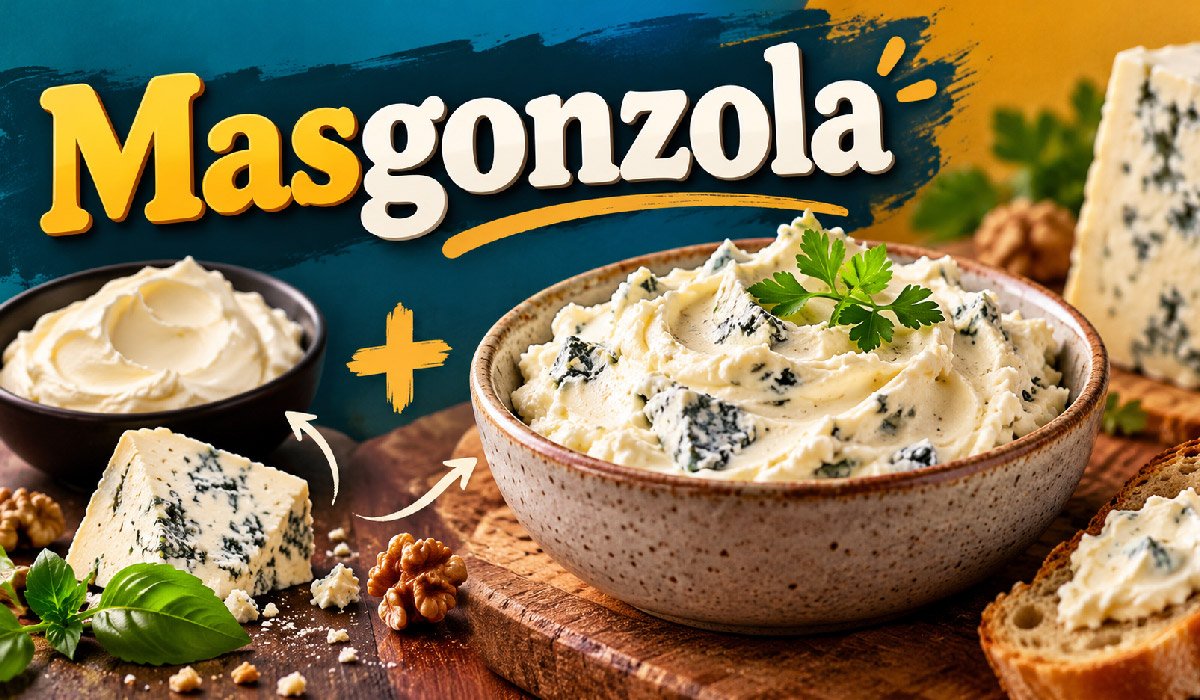
Masgonzola is a creamy cheese specialty that brings together the bold character of Gorgonzola and the smooth richness of mascarpone. The combination creates a softer blue-cheese experience that can appeal to people who find traditional Gorgonzola too sharp or intense.
Its name may sound like a separate Italian cheese variety, but Masgonzola is generally used for products combining Gorgonzola with mascarpone. Depending on the producer, these two components may be blended completely or arranged in attractive layers before the product is sold.
What makes Masgonzola interesting is its balance. Gorgonzola contributes salty, tangy, earthy flavors, while mascarpone adds mildness, richness, and a velvety texture. Together, they create a versatile specialty suitable for spreading, melting, serving, and adding to different recipes.
This guide explains what Masgonzola is, how its ingredients influence its flavor, and how it differs from Gorgonzola and mascarpone. You will also learn about nutrition, serving ideas, food pairings, storage, buying tips, and common misunderstandings surrounding this unusual cheese combination.
What Is Masgonzola?
Masgonzola is best understood as a specialty combining Gorgonzola blue cheese with mascarpone. It is not simply another name for Gorgonzola. Adding mascarpone changes both the texture and flavor, producing something noticeably softer, richer, creamier, and generally less intense.
Gorgonzola is the part responsible for the characteristic blue-cheese personality. It contributes saltiness, tanginess, earthy aromas, and blue-green veining. Mascarpone works differently. Its mild dairy flavor and high-fat creaminess soften those stronger characteristics and create a smoother overall eating experience.
There is no single formula that defines every Masgonzola product. One producer may use approximately equal quantities of both components, while another may change their proportions. The cheeses can also be layered instead of fully blended, creating differences between individual products.
This variation is important when buying Masgonzola. Two packages carrying similar descriptions can differ in flavor, texture, nutrition, and intensity. Reading the ingredient and nutrition labels is therefore more reliable than assuming every Masgonzola product will have exactly the same characteristics.
Where Does the Name Masgonzola Come From?
The name Masgonzola is a straightforward combination of two familiar cheese names. The opening “Mas” points to mascarpone, while “gonzola” comes from Gorgonzola. The word therefore provides a useful clue about what consumers should expect inside the product.
This naming style also explains why Masgonzola should not automatically be treated as a traditional cheese category with centuries of independent history. It is more accurately understood as a convenient name for a culinary combination built from two established Italian dairy products.
Depending on the shop, country, or producer, similar products may appear under other descriptions. Shoppers can encounter names such as Gorgonzola with mascarpone, Gorgonzola-Mascarpone, or the Italian-style wording Gorgonzola e Mascarpone instead of seeing “Masgonzola” printed prominently.
The distinction matters because online descriptions sometimes present Masgonzola as though it were an independently aged blue cheese. That can be misleading. Gorgonzola undergoes its recognized cheese-making process first, while mascarpone is produced separately before the two components are combined.
What Is Masgonzola Made From?
The defining ingredients are Gorgonzola and mascarpone. Gorgonzola is an Italian blue-veined cow’s-milk cheese with a distinctive savory character. Its blue-green appearance results from mold cultures used during production, which contribute significantly to the cheese’s aroma, flavor, and recognizable appearance.
Mascarpone is very different. It is a fresh, rich dairy product traditionally associated with Italian cooking and desserts. Its smooth consistency and mild taste provide a creamy counterweight to Gorgonzola, helping reduce the impression of sharpness without completely covering the blue cheese flavor.
When combined, these contrasting components complement each other. Mascarpone provides richness and softness at the beginning of each bite, while Gorgonzola follows with savory, salty, and earthy notes. The exact balance depends heavily on how much of each component is included.
Additional ingredients can vary between commercial products, so consumers should check individual labels rather than relying on a universal ingredient list. This is especially important for people concerned about allergens, enzymes, additives, salt levels, lactose, or whether a particular product meets their dietary requirements.
What Does Masgonzola Taste Like?
Masgonzola generally has a creamy, buttery, tangy, and mildly salty taste. Compared with eating Gorgonzola alone, the blue-cheese character normally feels softer because mascarpone provides considerable richness and a mild dairy flavor that balances the stronger savory notes.
The first impression can be surprisingly gentle. Mascarpone coats the palate with a smooth, rich texture before Gorgonzola’s more recognizable characteristics become noticeable. Depending on the mixture, the finish may contain earthy, savory, slightly pungent, or pleasantly sharp blue-cheese notes.
Intensity varies considerably. A version containing more mascarpone may taste mild enough for someone who normally avoids strong blue cheeses. A Gorgonzola-heavy version can retain much more saltiness, aroma, and tang, although its texture may still feel creamier than plain Gorgonzola.
Serving temperature also affects the experience. Straight from the refrigerator, Masgonzola is usually firmer and its flavors can seem restrained. Allowing a serving to soften slightly can improve spreadability and make its aromas and flavors easier to notice while eating.
Texture and Appearance of Masgonzola
Texture is one of Masgonzola’s strongest attractions. Mascarpone gives the product a dense yet velvety creaminess, while Gorgonzola adds more structure. The result is generally soft enough for spreading while retaining enough body to serve neatly on bread or a cheeseboard.
Appearance depends on the production style. Layered Masgonzola can show clear sections of pale mascarpone alongside blue-veined Gorgonzola. This creates an attractive contrast between creamy white or ivory areas and the greenish-blue markings associated with the Gorgonzola component.
Blended versions look more uniform. Instead of clearly separated layers, blue-cheese pieces or veins may be distributed throughout a creamy base. Their consistency can also make these products particularly convenient for dips, crostini, sandwiches, sauces, and other dishes requiring easy spreading.
Masgonzola becomes softer as its temperature rises, which also explains why it melts effectively in cooking. However, softness should not be confused with spoilage. Consumers should learn the normal color, smell, and texture of their particular product before judging unusual changes.
Masgonzola vs. Gorgonzola
The biggest difference between Masgonzola and Gorgonzola is composition. Gorgonzola is a recognized Italian blue cheese, whereas Masgonzola combines Gorgonzola with mascarpone. Adding mascarpone substantially changes the final product’s texture, intensity, richness, appearance, and possible culinary applications.
Plain Gorgonzola provides a more direct blue-cheese experience. Depending on its style and maturity, it can range from relatively soft and sweet to firmer and more assertive. Masgonzola generally moves the experience toward a milder, creamier, more easily spreadable direction.
Their regulatory identities are also different. Gorgonzola has Protected Designation of Origin status in the European Union and is subject to defined production requirements. Masgonzola is not an equivalent standalone PDO cheese designation and should not be presented as one.
For cooking, choosing between them depends on the desired result. Gorgonzola works well when a recipe needs pronounced blue-cheese flavor or crumbles. Masgonzola is particularly useful when you want Gorgonzola character combined with an already creamy consistency for spreading or melting.
Masgonzola vs. Mascarpone
Mascarpone alone is much milder than Masgonzola. It has a rich, creamy character without the blue veins, salty intensity, and earthy aroma supplied by Gorgonzola. This mild profile explains why mascarpone is commonly associated with both savory preparations and famous desserts.
Masgonzola takes that creamy foundation in a savory direction. Adding Gorgonzola introduces considerably more flavor, making the finished combination suitable for dishes where plain mascarpone could taste too neutral. Even a modest amount of blue cheese can make a noticeable difference.
Their culinary roles consequently overlap only in certain situations. Both can provide creaminess to sauces, but Masgonzola also adds blue-cheese flavor. Mascarpone is more suitable when neutral richness is required, especially in sweet recipes where Gorgonzola’s saltiness would be inappropriate.
If Masgonzola is unavailable locally, combining mascarpone and Gorgonzola at home can produce a similar result. Start with more mascarpone for a gentle flavor, then gradually add Gorgonzola until the mixture reaches the preferred balance of creaminess, saltiness, and tang.
How to Use Masgonzola in Cooking
Pasta is one of the easiest ways to use Masgonzola. Add a modest portion to freshly cooked pasta over gentle heat, then loosen it with a little reserved pasta water. The cheese can transform into a smooth sauce without requiring large quantities of additional cream.
It can work particularly well with gnocchi, ravioli, pappardelle, or other pasta capable of carrying a rich sauce. Ingredients such as mushrooms, walnuts, pears, spinach, or caramelized onions can complement its combination of creamy sweetness and savory blue-cheese character.
Masgonzola can also be used on pizza and flatbread. Small portions distributed across the surface provide creamy pockets of flavor as they melt. Pear, onion, walnuts, mushrooms, and leafy greens are possible partners when building a balanced sweet-and-savory topping combination.
Risotto offers another practical use. Stir a small amount into the rice near the end of cooking rather than boiling it aggressively. This preserves a smoother texture while adding richness. Because Masgonzola already contains mascarpone, extra butter or cream may not be necessary.
Easy Ways to Serve Masgonzola
Masgonzola does not need cooking to be enjoyable. Spread it over toasted baguette, crackers, crostini, or rustic bread for a quick appetizer. Its soft consistency makes serving simple, while its distinctive flavor means a relatively small amount can provide plenty of character.
Fresh fruit creates a useful contrast with its savory qualities. Pears, apples, grapes, and figs can provide sweetness and freshness against the salty Gorgonzola component. Dried figs, apricots, or dates can create an even richer combination for entertaining or cheeseboards.
Nuts provide another layer of texture. Walnuts are a classic partner for blue-cheese flavors, but almonds, pecans, and hazelnuts can also work. A small drizzle of honey can further soften the salty edge and connect the cheese with sweeter accompaniments.
Keep the overall arrangement relatively simple. Masgonzola already contains several flavor dimensions, including dairy richness, saltiness, tang, and earthy notes. Too many intensely flavored accompaniments can compete with it instead of complementing it, particularly when serving a more Gorgonzola-forward variety.
Masgonzola Nutrition and Calories
Masgonzola does not have one universal nutritional profile because its composition can differ by manufacturer. The proportion and specific varieties of Gorgonzola and mascarpone influence calories, total fat, saturated fat, protein, carbohydrates, sodium, and other values in the finished product.
Both components contribute nutritional value, but Masgonzola is typically an energy-dense food. Mascarpone is particularly rich in fat, while Gorgonzola contributes protein, calcium, fat, and sodium. Combining them therefore produces a rich food that is generally best enjoyed in sensible portions.
Some commercial examples can provide roughly 100 calories or more in a small 30-gram serving, but this should be treated only as a general reference. Exact numbers should always come from the nutrition panel on the particular package being consumed.
Masgonzola can fit into a balanced diet when portion size and overall eating patterns are considered. Pairing a modest serving with fruit, vegetables, or whole-grain bread can provide variety without turning a small cheese portion into an unnecessarily calorie-heavy meal.
Is Masgonzola Healthy?
Calling Masgonzola simply healthy or unhealthy overlooks how nutrition works. It can provide useful nutrients, including protein and calcium, but it can simultaneously contain substantial calories, saturated fat, and salt. Serving size and frequency therefore matter when including it in a diet.
Protein supports many functions in the body, while calcium is important for bones and teeth. However, Masgonzola should not be treated as a special health food simply because dairy products contain these nutrients. Other foods can provide protein and calcium with different nutritional profiles.
People who need to limit saturated fat, sodium, or total calories should pay particular attention to serving size and product labels. Different Masgonzola formulations may produce meaningfully different nutritional numbers, making package-specific information more useful than generic online estimates.
Masgonzola also contains milk and is unsuitable for anyone with a milk allergy. People with lactose intolerance should not assume every version is lactose-free. Because mascarpone is included, lactose content can vary, so consumers requiring lactose-free foods should verify individual product labeling.
How to Buy Good Masgonzola
Finding Masgonzola can require looking beyond its exact name. Specialty cheese counters, Italian food stores, larger supermarkets, and online food retailers may carry the product, but the package could instead say Gorgonzola-Mascarpone, Gorgonzola with Mascarpone, or Gorgonzola e Mascarpone.
Read the ingredient list before purchasing. This confirms what the product actually contains and may reveal the proportions used. It also provides essential information for people checking milk allergens, enzymes, additives, preservatives, or other ingredients relevant to their dietary choices.
The nutrition panel deserves similar attention. Since there is no single Masgonzola recipe, calories and quantities of fat, saturated fat, protein, carbohydrates, and salt can vary. Comparing labels is useful if you are choosing between several commercially available versions.
Finally, check refrigeration conditions, package integrity, and the use-by date. A chilled dairy product should be handled according to the manufacturer’s instructions. Avoid damaged, leaking, unusually swollen, or improperly refrigerated packaging, and follow any specific guidance printed on the label.
How to Store Masgonzola Safely
Masgonzola is a perishable dairy product and should remain refrigerated. The safest temperature and handling instructions are those stated by its manufacturer. After serving, return unused cheese to refrigeration promptly instead of leaving it sitting at room temperature for extended periods.
After opening, keep the product properly covered. Its original resealable packaging may be suitable, or it can be transferred to an appropriate food container. Good storage reduces drying, limits cross-contamination, and prevents strong cheese aromas from spreading to neighboring refrigerated foods.
Use clean utensils whenever serving Masgonzola. Introducing crumbs or other foods into a container can shorten its useful life. The manufacturer’s use-by date and after-opening directions should take priority over a generic claim that every Masgonzola remains fresh for the same number of days.
Recognizing spoilage requires care because blue-green mold is already normal in Gorgonzola. Look instead for unexpected changes from the product’s usual appearance, odor, or texture. When storage conditions are uncertain or the product appears genuinely abnormal, the safer option is to discard it.
Final Thoughts
Masgonzola offers an appealing middle ground between the boldness of Gorgonzola and the luxurious creaminess of mascarpone. Instead of being treated as an entirely separate ancient cheese variety, it is more accurately understood as a specialty combining these two contrasting Italian dairy products.
Its greatest strength is versatility. Masgonzola can be spread over bread, served with fruit and nuts, melted into pasta, stirred into risotto, or added to pizza. Its creamy consistency makes blue-cheese flavor accessible in dishes where plain Gorgonzola might feel overpowering.
Consumers should remember that Masgonzola is not governed by one universal recipe. Flavor, ingredient ratios, nutrition, storage life, and intensity can differ between manufacturers. Checking the actual package is therefore important, particularly when allergens, lactose, salt, calories, or other dietary considerations matter.
For people who enjoy creamy cheeses but want more character than plain mascarpone provides, Masgonzola can be an interesting option. Its combination of richness, tanginess, and smooth texture demonstrates how two familiar cheeses can create a distinctive experience when brought together carefully.
(FAQs)
What is Masgonzola?
Masgonzola is a cheese specialty that combines Gorgonzola and mascarpone. Gorgonzola supplies tangy, salty, earthy blue-cheese flavors, while mascarpone adds richness and smoothness. The resulting product is normally softer and milder than eating traditional Gorgonzola by itself.
Is Masgonzola the same as Gorgonzola?
No. Gorgonzola is a recognized Italian blue cheese with PDO protection, while Masgonzola combines Gorgonzola with mascarpone. This addition changes its consistency and taste, making Masgonzola generally creamier, richer, easier to spread, and less intense than plain Gorgonzola.
Is Masgonzola an official Italian cheese?
Masgonzola should not be confused with a separate PDO cheese designation. The name is commonly associated with a specialty combining Gorgonzola and mascarpone. Similar products can consequently appear under different commercial names, recipes, proportions, and presentation styles depending on the producer.
What does Masgonzola taste like?
Masgonzola usually tastes creamy, buttery, savory, salty, and gently tangy, with earthy blue-cheese notes. Its exact intensity depends on its composition. A mascarpone-heavy mixture tastes milder, while a product containing more Gorgonzola delivers a stronger and more noticeable blue-cheese character.
What is the best way to eat Masgonzola?
Masgonzola can be spread on bread, toast, crackers, or crostini and served alongside pears, figs, grapes, honey, or walnuts. It also melts effectively, making it useful in pasta sauces, risotto, pizza, gnocchi, flatbreads, and several savory appetizers.
Can I make Masgonzola at home?
Yes. A simple homemade alternative can be prepared by combining mascarpone with Gorgonzola until the desired taste and consistency are reached. Begin with more mascarpone for mildness, then gradually increase the Gorgonzola if you prefer stronger saltiness, tanginess, and blue-cheese flavor.
Is Masgonzola lactose-free?
Masgonzola should not automatically be considered lactose-free because it contains both Gorgonzola and mascarpone, and the finished lactose level can depend on the ingredients used. People who need lactose-free foods should check the specific product label rather than relying on general claims.
How should Masgonzola be stored?
Masgonzola should remain refrigerated and properly covered after opening. Follow the temperature, use-by date, and after-opening instructions printed on its package because shelf life varies between products. Use clean utensils and return unused cheese to refrigeration promptly after serving.
you may also read: Jipinfeiche Explained: Meaning, Games & Need for Speed









Discussion about this post