

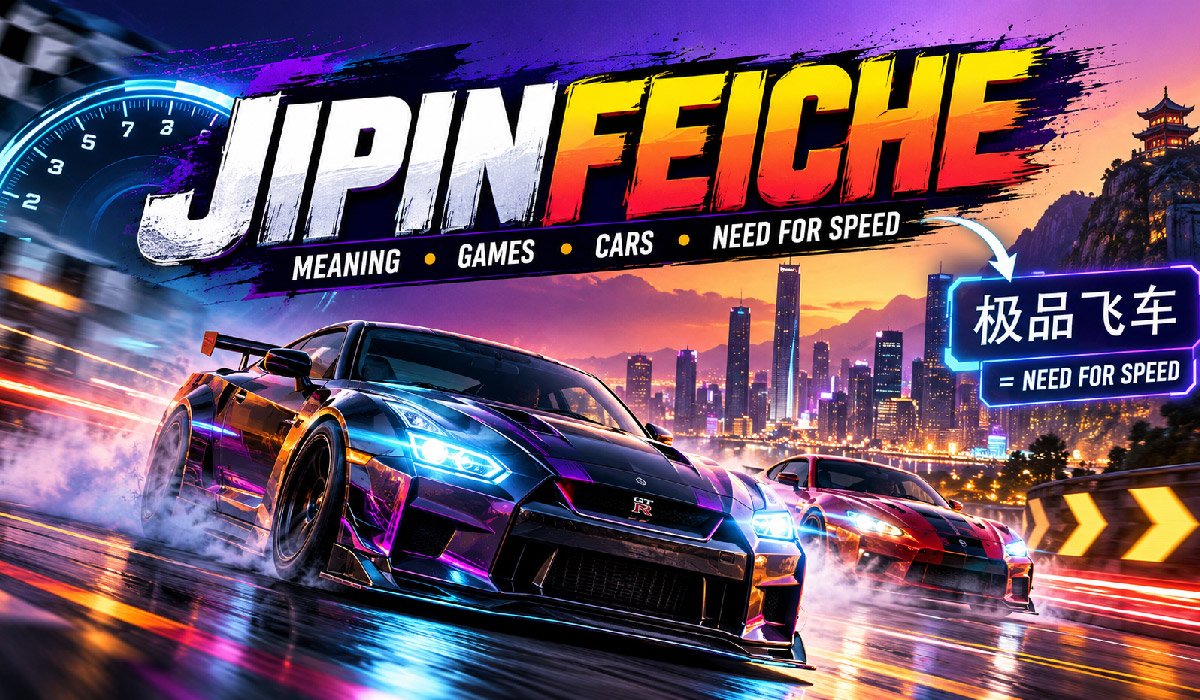
If you recently discovered Jipinfeiche while searching for racing games, the unusual name may leave you wondering what it represents. It can look like a new gaming company, racing application, automobile brand, or unfamiliar online service at first glance.
The explanation is much simpler. Jipinfeiche comes from the Mandarin pinyin Jípǐn Fēichē, written as 极品飞车 in Simplified Chinese. This is the localized name Electronic Arts uses for its internationally famous Need for Speed racing-game franchise in mainland China.
Understanding this connection clears up much of the confusion surrounding the keyword. It also explains why searches for Jipinfeiche can lead to racing videos, Need for Speed games, Chinese mobile releases, car customization guides, police pursuits, and gaming communities.
This guide explains what Jipinfeiche means, where the name comes from, its relationship with Need for Speed, important games in the franchise, mobile gaming, customization, safety, and common misconceptions. It provides a straightforward introduction for readers unfamiliar with the Chinese name.
What Is Jipinfeiche?
Jipinfeiche is a simplified Latin-letter spelling of Jípǐn Fēichē, the pinyin pronunciation of the Chinese characters 极品飞车. In the gaming world, these characters are strongly associated with Electronic Arts’ Need for Speed racing franchise in Simplified Chinese localization.
It is therefore misleading to present Jipinfeiche as an independent international racing franchise. A person encountering the term on a Chinese gaming page, video, app listing, or discussion is usually seeing a reference connected with Need for Speed.
The term can represent the broader franchise rather than one particular game. Need for Speed has received numerous releases across different generations, so the surrounding title, platform, release date, or additional Chinese characters are important when identifying a particular product.
This distinction also explains apparently different search results. Queries such as “Jipinfeiche mobile,” “Jipinfeiche Unbound,” and “Jipinfeiche cars” may all concern Need for Speed, but each query represents a different part of the much larger racing-game ecosystem.
What Does Jipinfeiche Mean?
The original writing is 极品飞车, while the standard pinyin representation is Jípǐn Fēichē. Internet users often remove Mandarin tone marks and the space between the words, producing the much simpler spelling Jipinfeiche commonly seen in English-language search results.
The first part, 极品 (jípǐn), can describe something exceptional, top-grade, or of particularly high quality depending on context. The second part, 飞车 (fēichē), relates to a fast-moving or speeding vehicle and strongly suggests high-speed driving.
A word-for-word English translation is not the best method for identifying the game. Literal interpretations can produce awkward phrases that are not official English product names. Localization frequently chooses wording that communicates an idea rather than reproducing every original word directly.
For gamers, the useful relationship is straightforward: 极品飞车 is associated with Need for Speed in Simplified Chinese localization. Recognizing that relationship is more useful than attempting to turn each Chinese character into an unofficial English franchise title.
Why Is Jipinfeiche Connected to Need for Speed?
Need for Speed is a long-running racing franchise published by Electronic Arts (EA). Its history reaches back to 1994, when the original The Need for Speed appeared during the early years of 3D racing games and home multimedia systems.
As Need for Speed reached international audiences, the franchise required localization for different languages and markets. 极品飞车 became its familiar Simplified Chinese identity, giving Chinese players a recognizable localized name while the international market continued using Need for Speed.
The franchise has changed considerably since its beginning. Individual releases have explored exotic-car racing, underground street culture, extensive vehicle modification, open environments, narrative campaigns, competitive multiplayer, drifting, and some of the most recognizable police pursuits in arcade racing.
Because many releases sit underneath the same franchise, Jipinfeiche should not automatically be treated as one particular game. Identifying words such as Unbound, Heat, Most Wanted, Underground, or Hot Pursuit makes a search much more precise.
Why Jipinfeiche Can Be Confusing Online
The joined spelling Jipinfeiche does not immediately look Chinese to readers unfamiliar with pinyin. Without the original characters or tone marks, it can easily resemble a modern company name, software platform, technology startup, website, or newly launched digital product.
Search content can increase that confusion. Unusual keywords sometimes attract articles that assign unsupported definitions to them. Jipinfeiche has consequently been described online in ways that have little obvious relationship with the documented use of 极品飞车 in Chinese gaming.
Claims describing it primarily as an ancient philosophy, productivity framework, traditional food, automobile manufacturer, or unrelated lifestyle movement require credible evidence. Such interpretations should not replace the much clearer and established connection between 极品飞车 and Electronic Arts’ Need for Speed franchise.
A simple research method prevents most confusion: identify the original characters first. Following Jipinfeiche → Jípǐn Fēichē → 极品飞车 makes the gaming connection much easier to recognize and prevents a romanized spelling from being mistaken for an unrelated brand.
The History Behind the Need for Speed Series
The first Need for Speed arrived in 1994 and helped establish a franchise built around desirable cars and high-speed driving. Later games experimented with different environments and mechanics rather than following one unchanged formula for every new generation.
The series became particularly influential through games such as Hot Pursuit, Underground, Underground 2, Most Wanted, Carbon, and later titles. Different eras attracted different audiences, from exotic-car enthusiasts to players interested in street racing, modification, drifting, and police pursuits.
Customization became especially important during the Underground era. Players could transform vehicles visually while improving performance, helping create a stronger sense of ownership. Police pursuits became another major franchise identity, particularly through releases such as Hot Pursuit and Most Wanted.
More recent games have continued experimenting with open environments, online features, detailed customization, and modern presentation. This changing design philosophy explains why two games carrying the Need for Speed name can offer noticeably different experiences while remaining part of Jipinfeiche’s broader franchise context.
Popular Games Associated With Jipinfeiche
Need for Speed: Underground and Underground 2 became closely associated with street-racing culture and extensive customization. Underground 2 expanded exploration through an open city, while both games helped make modified cars and visual personalization central parts of the franchise’s identity.
Need for Speed: Most Wanted, particularly the well-known 2005 release, combined illegal street racing with intense police pursuits and progression against rival drivers. Its combination of speed, pursuit pressure, memorable vehicles, and career progression helped it become a highly recognized franchise entry.
Other releases explored different directions. Hot Pursuit emphasized competition between racers and police, while Carbon developed street-racing and territory ideas. Later games including Rivals, Payback, Heat, and Hot Pursuit Remastered continued adapting familiar elements for newer gaming hardware.
Need for Speed Unbound, released in 2022, introduced a distinctive visual approach combining realistic vehicles with stylized graphical effects. Set around Lakeshore, it features street racing, car customization, police pressure, progression, and multiplayer elements while continuing several established Need for Speed traditions.
Jipinfeiche Gameplay and Racing Style
Need for Speed generally sits closer to arcade racing than a strict motorsport simulation. Accessibility is a major part of its identity. Players can quickly begin driving powerful vehicles without first mastering the complicated procedures associated with highly realistic racing simulators.
That accessibility does not mean every race requires no skill. Braking points, corner entry, vehicle control, route knowledge, acceleration, overtaking, and avoiding unnecessary collisions can all influence results. Experienced players often become considerably faster through consistent driving rather than raw vehicle power alone.
Individual Need for Speed games can feel different. Some emphasize drifting and street competition, others make police pursuits central, and some provide large environments for exploration. Handling systems also change between releases, meaning techniques learned in one title may require adjustment elsewhere.
This variety is one reason Jipinfeiche searches cover so many topics. Someone may be researching racing techniques, drift builds, pursuit strategies, multiplayer, collectibles, specific vehicles, or story progression while still searching within the same broader Need for Speed franchise.
Cars and Customization in Jipinfeiche
Cars are naturally central to the Need for Speed experience. Across its history, the franchise has featured vehicles from numerous established manufacturers. Exact car lists differ between releases because licensing agreements, game design, setting, and progression systems change from title to title.
Many games allow players to modify vehicle appearance. Depending on the release, options can include body components, wheels, paint, wraps, decals, spoilers, stance, exhausts, and other details. These systems let players create designs that look substantially different from standard factory cars.
Performance modification can be equally important. Engines, forced induction, tires, brakes, suspension, transmission components, and other systems may influence acceleration, maximum speed, grip, handling, or overall performance depending on the mechanics used by the particular Need for Speed game.
The strongest build is not necessarily the one displaying the biggest number. A vehicle needs to suit the event and player’s driving style. Technical roads may reward control and acceleration, while longer, faster routes can place greater importance on high-speed performance.
Police Chases and Open-World Racing
Police pursuits are among the most recognizable features associated with Need for Speed. Instead of simply racing from start to finish, players in many entries must also avoid police vehicles, roadblocks, pursuit tactics, and escalating law-enforcement pressure while protecting their progress.
This mechanic changes the emotional pace of the game. A completed race does not always mean immediate safety. Depending on the title, players may need to escape a pursuit afterward, creating additional risk and making ordinary roads part of the challenge.
Open-world design has also played an important role in numerous releases. Rather than limiting players entirely to isolated racing circuits, these games allow them to explore roads, find events, discover activities, reach garages, encounter opponents, or simply drive around the environment.
Not every Need for Speed game uses these elements in exactly the same way. That difference matters when choosing a title. Players interested primarily in police action, customization, exploration, drifting, or traditional racing should examine the features of the individual release first.
Jipinfeiche Mobile and 极品飞车:集结
Jipinfeiche also appears in mobile gaming searches because the Need for Speed brand extends beyond traditional PC and console releases. One particularly relevant Chinese title is 极品飞车:集结, a mobile racing game associated with Tencent’s TiMi development operation and EA authorization.
The game takes the familiar racing brand into a large mobile-focused environment. Its published feature descriptions emphasize open-world driving, multiplayer activities, licensed vehicles, exploration, customization, competitive racing, police-related gameplay, and social systems designed around connected mobile players.
This should not be confused with every other Need for Speed release. The additional Chinese characters 集结 identify a specific product. Searching only Jipinfeiche can therefore hide an important distinction between the general franchise and a particular Chinese mobile title.
Mobile availability can also differ by region. Players should check an official app marketplace and confirm the developer, publisher, supported region, and device requirements before installing anything. An unofficial APK carrying a familiar gaming name should never automatically be considered an authorized release.
Is Jipinfeiche the Same in Every Chinese Market?
There is another localization detail worth understanding. 极品飞车 is strongly associated with the franchise in Simplified Chinese, particularly mainland Chinese localization. However, Chinese-language markets do not necessarily use one identical title for every localization of Need for Speed.
Traditional Chinese localization has commonly used 極速快感 for Need for Speed. Therefore, saying that every Chinese-speaking player universally calls the franchise Jipinfeiche would oversimplify the situation. Regional language conventions and localization decisions need to be considered separately.
This difference also helps explain why searches conducted with Traditional Chinese characters may produce different titles from searches using Simplified Chinese. Both sets of results can still concern the same international Need for Speed franchise despite displaying noticeably different localized names.
For SEO and research purposes, this distinction is useful. Jipinfeiche is best explained specifically through 极品飞车 and Simplified Chinese localization, rather than being described broadly as the only Chinese name used for Need for Speed everywhere.
Is Jipinfeiche a Car Company or Website?
Jipinfeiche should not be described as a verified automobile manufacturer simply because its Chinese wording is connected with fast cars. Need for Speed features vehicles produced by real manufacturers, but the localized franchise name does not turn Electronic Arts’ racing series into a car company.
Similarly, Jipinfeiche is not, by definition, one specific website. Websites, gaming communities, video channels, download pages, or blogs may use the keyword because people search for it, but that does not change the established meaning of the underlying Chinese gaming title.
This distinction becomes particularly important when unfamiliar websites present themselves around popular search terms. A page containing Jipinfeiche in its title or domain should not automatically be considered an official Electronic Arts or Need for Speed resource without further verification.
Look for recognizable publisher information, legitimate platform listings, correct game details, and secure distribution channels. The keyword can help you find content, but the presence of a familiar franchise term alone cannot establish the legitimacy or safety of a website or download.
How to Download Jipinfeiche Safely
Players searching for Jipinfeiche downloads should first identify the exact Need for Speed title they want. Different games support different systems, and a PC release, console game, and China-focused mobile title may have completely different availability and installation requirements.
Official publisher pages and established digital stores are the safest starting points. Depending on the game and platform, legitimate distribution can involve the EA app, Steam, PlayStation Store, Xbox Store, Apple App Store, or another officially supported marketplace.
Extra caution is needed with websites offering cracked installers, modified APK files, unlimited-currency versions, cheat packages, or unknown launchers. Such downloads may introduce malware, unwanted software, account theft, corrupted game files, or other security and privacy problems.
Before installing anything, verify the exact game name, publisher, developer, platform, region, and store listing. This small check is especially useful with Jipinfeiche because romanized searches can produce unofficial pages that look unrelated to the original Chinese Need for Speed branding.
Why Jipinfeiche Still Attracts Racing Fans
Need for Speed has remained recognizable because it offers something different from highly technical racing simulators. The series typically focuses on excitement, dramatic speed, desirable cars, customization, accessible driving, and memorable environments instead of requiring players to reproduce professional motorsport procedures.
The franchise also carries considerable nostalgia. Different generations remember different titles: some prefer Underground 2, others remember Most Wanted, while newer players may have entered through Heat or Unbound. Those different entry points keep older games part of current gaming discussions.
Customization gives players another reason to remain engaged. Building a garage, experimenting with vehicle designs, improving performance, finding preferred cars, and testing different driving styles can create objectives beyond simply reaching the end of a campaign.
Online discussion extends that interest further. Players exchange builds, videos, screenshots, racing techniques, car recommendations, and opinions about different releases. As a result, both the English Need for Speed name and Chinese Jipinfeiche-related searches continue connecting players with decades of racing content.
Final Thoughts
Jipinfeiche may initially sound like an unknown company, technology platform, or independent racing game, but its meaning becomes clear when the original language is considered. It comes from Jípǐn Fēichē (极品飞车), associated with Need for Speed in Simplified Chinese localization.
The term can lead to many parts of the franchise, including classic Need for Speed releases, modern games, vehicle customization, police pursuits, open-world racing, multiplayer content, and Chinese mobile titles. The surrounding context therefore determines which specific game a search actually concerns.
It is also important to separate documented gaming usage from unsupported online definitions. Claims presenting Jipinfeiche primarily as an ancient philosophy, productivity system, traditional food, or automobile manufacturer should not be accepted without strong independent evidence supporting those completely different interpretations.
For most gamers, the simplest explanation remains the most useful: Jipinfeiche connects the Simplified Chinese name 极品飞车 with Electronic Arts’ Need for Speed franchise. Once that relationship is understood, confusing search results become much easier to identify and navigate.
(FAQs)
What is Jipinfeiche?
Jipinfeiche is the joined, unaccented spelling of Jípǐn Fēichē (极品飞车). In gaming, the Chinese title is associated with Electronic Arts’ Need for Speed franchise in Simplified Chinese localization.
Is Jipinfeiche the same as Need for Speed?
Yes, in the relevant Simplified Chinese gaming context. 极品飞车 is used for Need for Speed. Jipinfeiche is a Latin-letter representation of the Mandarin pronunciation rather than the name of an unrelated international racing franchise.
Is Jipinfeiche a separate racing game?
Not generally. Jipinfeiche can refer to the broader Need for Speed franchise, so you need the complete title or context to determine whether someone means Unbound, Heat, Most Wanted, a mobile release, or another game.
What does Jipinfeiche mean in English?
A literal translation of the individual Chinese words can suggest exceptional or top-grade fast vehicles, but literal wording can be misleading. For gamers, the important meaning is its established localization connection with the Need for Speed franchise.
Is Jipinfeiche a car brand?
No. Jipinfeiche is not established as an automobile manufacturer like Ferrari, Porsche, BMW, or Lamborghini. The confusion probably comes from its racing-game context and the many licensed cars featured throughout Need for Speed games.
What is Jipinfeiche Mobile?
People using “Jipinfeiche mobile” may be looking for mobile Need for Speed content, particularly the Chinese title 极品飞车:集结. Users should identify the exact game and verify its official store listing before installing it.
Is Jipinfeiche safe to download?
The name itself is not a download. Safety depends on where a particular game or application comes from. Use official publisher pages and recognized stores, and avoid unknown APKs, cracked installers, modified clients, and suspicious third-party download websites.
Why is Jipinfeiche sometimes given different meanings online?
The romanized spelling looks unfamiliar when separated from its Chinese characters, which encourages misinterpretation. Returning to 极品飞车 makes its Need for Speed connection much clearer and helps distinguish established gaming usage from unsupported definitions published elsewhere.
you may also read: Thealitekeepsafe.com: Complete Guide to Safety and Features








Discussion about this post