

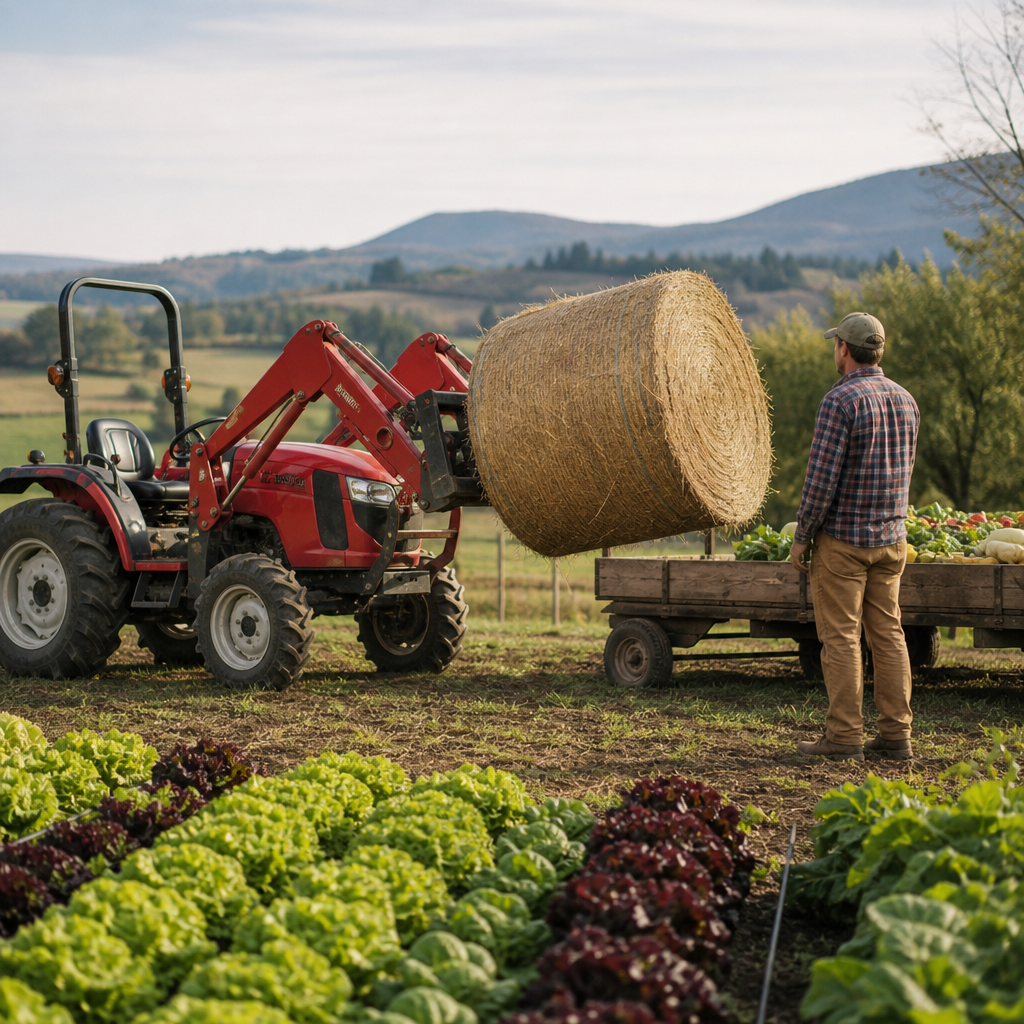
Most people who buy their first compact tractor buy the wrong one — usually by about twenty horsepower in one direction or the other. Too small, and the loader can’t pick up a round bale or a pallet of compost. Too large, and it compacts wet pasture, won’t fit between orchard rows, and burns more diesel than the job deserves. If you grow food on anything from five to a hundred and fifty acres, the tractor is the backbone of the operation, and getting the size and implement package right matters more than brand loyalty or cab options.
What follows is a practical framework for choosing, equipping and maintaining a compact or utility tractor on a small food-producing farm, written for growers who care about the crop and the customer rather than the spec sheet for its own sake.
Start with the jobs, not the horsepower
Write down every task the machine will do in a year, then note the two or three hardest. A tractor that handles your worst job comfortably will handle everything else. Typical lists on a diversified food farm look like this: mowing pasture and field edges, running a rotary tiller or bed shaper, hauling compost and produce bins with a loader, grading a gravel lane, lifting pallets at harvest, and — if you keep livestock — cutting, raking and baling hay.
Two of those jobs set the floor. Loader work determines the weight and lift capacity you need, and haying determines PTO horsepower. A 6-foot rotary cutter in heavy grass, a disc mower, or a small square baler all want more at the PTO than a sub-25-horsepower machine can deliver on a hot afternoon. By contrast, a market garden that never bales a thing can run beautifully on a small compact with a 5-foot tiller and a quick-attach loader.
Rough brackets to think in
- Sub-compact (roughly 20–25 hp): lawns, small gardens, light grading, a 4-foot mower. Gentle on turf, limited loader muscle.
- Compact (roughly 25–45 hp): the sweet spot for most diversified food farms — 5- to 6-foot implements, real loader capacity, mid-mount or rear mowing, light tillage.
- Utility (roughly 45–75 hp): hay ground, round balers, larger tillage, pallet forks with weight on them, and long hours in the field without straining.
The numbers on the spec sheet that actually decide things
Engine horsepower is marketing. PTO horsepower is what turns an implement. Then look at three-point hitch lift capacity at the ball ends — not at the pivot, which flatters the figure — because that number tells you whether a filled seeder or a loaded box blade will leave the ground. Hydraulic flow in gallons per minute determines how fast your loader cycles, which you will feel every single day of compost season. Finally, check the tractor’s bare weight: traction and stability come from mass, and a light machine with big numbers on the hood will spin its tires and tip its loader.
Tires and ballast deserve a decision, not a default. Industrial tires resist punctures around buildings and gravel; ag bar tires pull in soft ground and tear turf; turf tires protect sod and struggle in mud. Rear ballast — a filled implement, wheel weights or loaded tires — is not optional once a loader goes on the front, and skipping it is the most common cause of premature front axle wear on small tractors.
Building an implement package you will still like in year three
Package deals exist because dealers know which combinations work. A loader, a rotary cutter and a box blade cover eighty percent of rural property work. Add a tiller or disc harrow if you plant, pallet forks if you sell by the bin, and a rear blade if you maintain a lane through winter. Resist the urge to buy every attachment at once; buy the three you will use weekly, run them a season, then add what the work demands.
Hay is where small operations overreach. Cutting, curing and baling your own forage can pay off, but it needs four machines, dry weather windows and a willingness to watch moisture closely. Before committing, it is worth reading through published agricultural extension material on forage harvesting and equipment, then comparing honestly with the cost of buying hay locally. Plenty of livestock farms with under forty acres are better served by a mower conditioner and a custom baler than by owning the full line.
Parts, service and why the dealer relationship is part of the purchase
A tractor that is down during planting week costs far more than the part that broke. That is why the parts counter and the service bay should weigh as heavily in your decision as the machine itself — filter availability, loader pin kits, baler twine and knotter components, mower spindles, hydraulic hoses made up while you wait. Genuine parts matter most in three places: filtration, hydraulic seals and anything with a wear tolerance, because that is where aftermarket substitutes quietly shorten component life.
Growers across Kentucky, Tennessee and Indiana often sort this out by working with a full-line dealership rather than chasing parts online each time something fails. H&R Agri-Power is an authorized Kubota dealer selling new and used tractors and implements, pre-built and custom Kubota tractor packages, and genuine Kubota parts alongside general tractor, mower and baler parts, with repair and service available at its Kentucky, Tennessee and Indiana locations — including lawn mower repair in Owensboro. For a small farm, the practical value of that is simple: one place that knows your machine, stocks the filters it eats, and can take the mower in during the shoulder season rather than in July.
A seasonal service rhythm that prevents breakdowns
- Late winter: change engine oil and filters, service the air cleaner, test the battery, grease every loader and hitch pin, check coolant strength.
- Spring: inspect tires and set pressures, check hydraulic fluid and hoses for chafing, sharpen and balance mower blades, check three-point linkage for play.
- Hay season: daily grease on the baler, check knotters or belts before every field, carry spare twine, shear bolts and a hose.
- Autumn: wash the machine properly, touch up paint on chipped loader arms, change hydraulic and transmission filters at the stated interval.
- Before storage: top off fuel with a stabilizer, lower implements onto blocks, remove the battery if the tractor will sit for months.
The machine is also a marketing decision
Equipment choices shape what you can sell and how you present it. Pallet forks and clean bins mean you can supply a restaurant or a wholesale buyer without rehandling everything by hand. Reliable mowing and tidy field edges mean you can host farm visits. And the ability to harvest consistently is what lets a grower commit to the trade events where food exhibitions bring producers and enthusiasts together — appearances that depend entirely on having product ready on a fixed date.
So buy the tractor for the hardest job, ballast it properly, keep the implement list short and honest, and settle your parts and service arrangements before the first busy week rather than during it. A well-sized compact tractor, maintained on a calendar instead of in a panic, quietly disappears into the background of the farm — which is exactly what good equipment should do.









Discussion about this post