

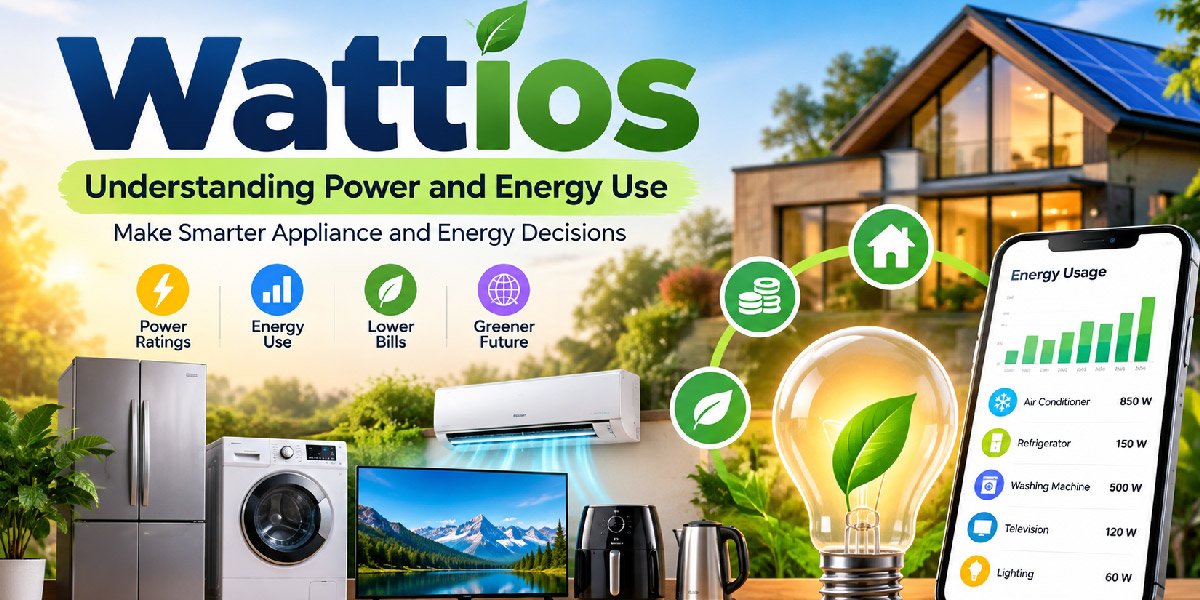
Understanding electricity use has become increasingly important as homes and businesses depend on more electrical devices. Wattios is a term people may encounter while researching watts, appliance power consumption, energy efficiency, electricity costs, and ways to make smarter decisions about everyday energy use.
The important point is that a power rating alone does not tell you exactly how much an appliance will cost to operate. Actual energy consumption depends on wattage, operating time, efficiency, settings, and user habits. Understanding these factors makes electricity use much easier to manage.
This guide explains Wattios in practical terms while covering watts, kilowatts, kilowatt-hours, appliance labels, electricity costs, energy efficiency, standby consumption, solar planning, and smarter appliance buying. It also separates useful electrical concepts from claims about Wattios that cannot be reliably verified.
What Is Wattios?
The term Wattios closely resembles vatios, the Spanish word for watts, and is commonly encountered online in discussions involving electricity, appliances, power ratings, and energy consumption. A watt is the standard unit used to measure electrical power and is represented by the symbol W.
It is important not to confuse online descriptions of Wattios with established electrical terminology. Claims may describe Wattios as an application, smart energy platform, AI system, or commercial product. Such descriptions should not automatically be accepted without reliable information from an identifiable official provider.
For practical purposes, people researching Wattios can benefit most from understanding watts and electricity consumption. These concepts help consumers compare appliances, estimate energy requirements, understand electricity bills, plan solar installations, and identify opportunities to reduce unnecessary household or business electricity use.
What Does a Watt Measure?
A watt measures power, meaning the rate at which energy is transferred or used. The unit is named after Scottish engineer James Watt. Electrical appliances normally display their rated power in watts or, for equipment requiring considerably more power, in kilowatts.
For example, an LED light might require around 10 watts, while an electric heater could require more than 1,000 watts. The higher figure indicates a greater rate of energy use while the equipment operates, but it does not automatically mean higher monthly consumption.
Operating time makes the difference. A powerful appliance running for several minutes can consume less energy overall than a low-power device operating continuously. Therefore, consumers should consider both the watt rating and expected operating duration when evaluating electricity consumption.
Watts and Kilowatts Explained
Electrical power is commonly expressed in watts and kilowatts. One kilowatt equals 1,000 watts. Therefore, an appliance rated at 2,000 watts can also be described as a 2-kilowatt appliance. Using kilowatts makes larger power values easier to read and calculate.
Watts describe the rate of power use at a particular moment. They are useful when comparing electrical loads, checking appliance specifications, evaluating generator capacity, or determining whether an electrical circuit can safely support several devices operating at the same time.
Kilowatts become especially useful when calculating energy consumption. Converting watts into kilowatts before multiplying the figure by operating hours provides a straightforward method of estimating kilowatt-hours, the measurement commonly associated with household and commercial electricity billing.
Watts and Kilowatt-Hours Are Different
One common electricity mistake is treating watts and kilowatt-hours as identical measurements. They describe different things. Watts measure power, while kilowatt-hours measure energy consumed over a period. Understanding this distinction makes appliance specifications and electricity bills considerably easier to interpret.
A 1,000-watt appliance operating for one hour uses approximately one kilowatt-hour of electrical energy. The same appliance running for thirty minutes would use approximately half a kilowatt-hour. This relationship provides a simple way to estimate appliance consumption.
The basic calculation is: appliance power in kilowatts × operating hours = energy consumption in kilowatt-hours. Real appliances can behave differently because thermostats, variable-speed motors, operating modes, and automatic controls may change their power draw while they are being used.
How Appliance Power Ratings Work
Most electrical appliances have a nameplate, label, manual, or technical specification showing important electrical information. Depending on the product, this may include rated voltage, frequency, current, input power, output power, model information, safety certifications, and other operating requirements.
The watt rating helps indicate the appliance’s electrical power requirements under specified conditions. However, rated power should not always be interpreted as constant consumption. Refrigerators, air conditioners, washing machines, and variable-speed equipment can cycle or adjust their power draw during operation.
Consumers should therefore use ratings as useful technical information rather than assuming that a device continuously consumes its maximum stated power. For accurate measurements, a compatible plug-in electricity monitor or professionally installed energy-monitoring equipment may provide more representative real-world consumption data.
How to Calculate Appliance Energy Use
Estimating appliance electricity consumption requires three basic pieces of information: wattage, operating time, and electricity price. Begin by converting watts to kilowatts. A 500-watt appliance, for example, has a power rating equivalent to 0.5 kilowatts.
If that appliance operates for four hours, the basic calculation is 0.5 kW × 4 hours, giving approximately 2 kWh of energy consumption. Multiplying the resulting kilowatt-hours by your utility’s applicable electricity rate provides a rough operating-cost estimate.
The calculation becomes less precise for appliances that automatically cycle on and off or change power during operation. Air conditioners, refrigerators, heat pumps, and washing machines are examples. Their published energy-consumption information can sometimes provide a better basis for long-term comparisons.
Why Operating Time Matters
High wattage does not necessarily mean that a device is responsible for the largest portion of an electricity bill. A powerful appliance used briefly may consume relatively little energy, while lower-powered equipment operating continuously can accumulate substantial consumption throughout the month.
Consider an electric kettle and refrigerator. A kettle can draw considerable power but usually operates for only several minutes. A refrigerator requires electricity throughout the day, although its compressor cycles. Consequently, monthly consumption cannot be compared simply by looking at their maximum watt ratings.
This principle applies throughout a home. Lighting, routers, computers, televisions, air conditioners, water heaters, fans, pumps, and kitchen equipment have different operating patterns. Evaluating wattage together with usage duration provides a much more realistic picture of household energy demand.
Wattios and Electricity Bills
Understanding the concepts associated with Wattios can make an electricity bill easier to analyze. Instead of viewing monthly consumption as one unexplained number, households can estimate how individual appliances and daily behaviors contribute to their overall energy demand.
Electricity bills can contain more than a simple charge for energy consumed. Depending on the utility and location, tariffs may include fixed charges, taxes, fuel adjustments, time-dependent rates, demand-related components, or tiered pricing. Consumers should examine their actual tariff before estimating savings.
For this reason, nobody can guarantee a fixed percentage reduction in electricity bills merely by understanding wattage or installing an energy-monitoring solution. Savings depend on existing consumption, appliance efficiency, electricity prices, climate, occupancy, behavioral changes, and the improvements actually implemented.
Choosing Energy-Efficient Appliances
Energy efficiency describes how effectively equipment provides a useful service while limiting unnecessary energy consumption. When comparing similar appliances, consumers should consider both purchase price and expected operating costs instead of automatically choosing whichever product has the lowest initial price.
For frequently used equipment, a more efficient model can potentially save energy throughout its working life. Refrigerators, freezers, air conditioners, water heaters, washing machines, dryers, and lighting are particularly worth evaluating because usage patterns can make efficiency differences meaningful over time.
Where available, consumers should examine recognized energy labels and standardized consumption figures. These can offer better comparisons than watt ratings alone. Appliance capacity also matters: buying equipment significantly larger than necessary can undermine potential efficiency benefits and increase acquisition costs.
Appliances That Can Drive Energy Consumption
Heating and cooling equipment can represent substantial electricity demand in many households, particularly where air conditioners, electric heaters, heat pumps, or electric water heaters operate frequently. Climate, insulation, thermostat settings, building design, and equipment efficiency all influence their actual consumption.
Refrigerators and freezers deserve attention because they operate continuously throughout the year. Their compressors cycle rather than running constantly, but inefficient models, poor ventilation, damaged door seals, unsuitable temperature settings, and maintenance problems can increase energy use over time.
Other contributors may include dryers, ovens, pumps, desktop computers, entertainment systems, lighting, and electric vehicle charging. The largest consumers differ between households, which is why measuring actual consumption is generally more useful than assuming every home follows an identical pattern.
Understanding Standby Power
Some electronic devices continue consuming small amounts of electricity when they appear to be switched off. This is known as standby power. Televisions, game consoles, chargers, printers, audio equipment, smart devices, and other electronics may use standby electricity depending on their design.
The consumption of one device may be small, but numerous connected products can increase total household standby demand. A plug-in electricity meter can help identify devices with measurable standby consumption rather than relying on assumptions about which electronics are responsible.
Unplugging suitable devices or using switched power strips may reduce unnecessary standby consumption. However, users should avoid disconnecting equipment that requires continuous power for safety, security, communications, software updates, timers, medical purposes, or other important functions.
Smart Energy Monitoring at Home
Energy monitors can provide more detailed information than a monthly electricity bill. Simple plug-in monitors measure individual appliances, while whole-home systems may measure circuits or overall electrical demand. The appropriate option depends on what the user wants to investigate.
Smart plugs can also provide consumption information when energy monitoring is included as a feature. More sophisticated systems may offer historical graphs, alerts, automation, or integrations. Their accuracy, compatibility, data collection practices, and capabilities vary considerably between manufacturers and product categories.
This is also why claims describing Wattios as a particular AI-powered monitoring ecosystem should be treated carefully unless supported by an official source. Consumers interested in smart monitoring should compare identifiable products based on documented functionality rather than relying solely on generalized online descriptions.
Simple Ways to Reduce Electricity Use
Reducing consumption often begins with simple actions rather than expensive technology. Switching off unnecessary lighting, selecting efficient lighting products, adjusting heating and cooling responsibly, and avoiding needless operation of equipment can reduce wasted energy without dramatically changing everyday routines.
Maintenance also matters. Cleaning appropriate filters, servicing heating or cooling equipment as recommended, checking refrigerator door seals, and keeping equipment in suitable operating conditions can support efficient performance. Users should always follow manufacturer instructions and use qualified technicians when electrical servicing is required.
Behavior should be combined with measurement. Reviewing electricity bills over several months, recording seasonal changes, and measuring major appliances can reveal where meaningful savings are possible. Focusing on the largest avoidable loads generally produces better results than obsessing over extremely small consumption differences.
Wattios and Solar Power Planning
Understanding household electricity consumption is particularly valuable when considering solar panels. Solar system design depends on more than appliance watt ratings. Installers normally consider historical energy consumption, available roof space, orientation, shading, local solar conditions, tariffs, and customer objectives.
Peak power demand is also different from total energy consumption. A household might consume a certain number of kilowatt-hours daily while simultaneously operating several high-power appliances for only a short period. Battery and inverter planning can therefore require information beyond monthly energy totals.
Anyone planning solar power should collect reliable consumption data and discuss system sizing with a qualified provider. Future requirements—including electric vehicles, additional air conditioning, home extensions, battery storage, or changes in occupancy—should also be considered when estimating long-term electricity demand.
How Businesses Can Manage Power Use
Businesses can apply the same basic electricity principles on a larger scale. Offices may evaluate lighting, computers, servers, heating, ventilation, and air conditioning, while restaurants can examine refrigeration and cooking equipment. Retail operations may focus heavily on lighting and climate control.
Larger commercial sites may benefit from submeters, building management systems, automated controls, energy audits, and equipment-level monitoring. These technologies can help identify unusual consumption patterns and provide data for operational decisions, maintenance programs, and energy-efficiency investments.
However, the best strategy depends on the organization. A small office and manufacturing facility have very different electrical profiles. Businesses should prioritize high-consumption systems, operating schedules, equipment condition, and measurable return on investment rather than implementing energy-saving measures without supporting data.
Common Electricity Mistakes to Avoid
One mistake is judging energy consumption from wattage alone. Another is assuming every appliance constantly uses its rated maximum power. Ignoring operating hours, duty cycles, variable-speed technology, thermostat behavior, and different operating modes can produce inaccurate energy and cost estimates.
Consumers should also avoid accepting dramatic savings claims without evidence. Statements promising a specific percentage reduction in electricity costs may not apply universally. Meaningful savings depend on the starting point, equipment, behavior, climate, tariff structure, and changes a household actually makes.
Finally, avoid purchasing appliances solely because their watt rating is lower. Performance, capacity, standardized efficiency information, durability, expected annual consumption, and suitability for the intended task all matter. Efficient energy management requires evaluating the complete product rather than one specification in isolation.
Tips for Smarter Appliance Buying
Before purchasing an appliance, determine the capacity and features you genuinely need. Oversized products can cost more to buy and may consume unnecessary energy. Compare equivalent models instead of comparing products designed for substantially different workloads, capacities, or performance levels.
Check recognized energy-efficiency information where available, alongside manufacturer specifications and expected annual energy consumption. Consider how frequently the appliance will operate. Efficiency becomes particularly important for equipment expected to run many hours every day or remain in service for several years.
Finally, think about total ownership cost. A cheaper appliance is not necessarily cheaper over its lifetime if it consumes considerably more energy or requires frequent maintenance. Purchase price, expected energy use, reliability, warranty, repairability, and useful features should all influence the final decision.
Benefits of Understanding Wattios
The biggest benefit of researching Wattios through the lens of electricity fundamentals is improved energy awareness. Understanding watts, kilowatts, kilowatt-hours, and operating time allows consumers to interpret technical specifications and estimate how everyday equipment can contribute to electricity consumption.
This knowledge also supports better purchasing decisions. Instead of selecting products purely by appearance, advertising, or initial price, buyers can compare efficiency and likely operating requirements. That approach is particularly valuable when purchasing equipment expected to operate frequently for many years.
Energy knowledge also supports future planning. Whether someone wants to lower household expenses, investigate unexpectedly high consumption, purchase backup power equipment, install solar panels, or manage business electricity demand, understanding power and energy measurements provides a useful technical foundation for better decisions.
Final Thoughts
Wattios is best approached carefully because online descriptions of the term are not always consistent. Rather than assuming it represents a verified AI platform or specific commercial energy product, readers should focus on the established electrical concepts surrounding watts, energy consumption, appliance efficiency, and power management.
Watts tell you how quickly electrical energy is being used, while kilowatt-hours tell you how much energy is consumed over time. Combining these measurements with appliance operating patterns provides a far more useful understanding of where electricity goes and what it may cost.
Ultimately, smarter energy management comes from accurate information, appropriate equipment, efficient appliances, sensible habits, and reliable measurements. Whether you are comparing a refrigerator, investigating an electricity bill, managing business equipment, or planning solar power, understanding electricity consumption can support better long-term decisions.
(FAQs)
What does Wattios mean?
Wattios is an online term associated with searches about watts, electrical power, appliances, and energy consumption. Because descriptions of the term vary, it should not automatically be treated as the name of a verified energy-management company or application without reliable official evidence.
Is Wattios a smart energy management platform?
Some online content describes Wattios as an AI-powered smart energy platform. However, such claims require verification from an identifiable official provider. Readers should distinguish these descriptions from established concepts such as watts, kilowatt-hours, smart meters, energy monitors, and home automation systems.
What is the difference between watts and kilowatt-hours?
Watts measure power, or the rate at which energy is used. Kilowatt-hours measure energy consumption over time. A 1,000-watt appliance operating continuously for one hour consumes approximately one kilowatt-hour of electricity.
How can I calculate the electricity used by an appliance?
Convert the appliance’s wattage into kilowatts by dividing by 1,000, then multiply that number by the hours of operation. For example, a 500-watt device running for two hours uses approximately 1 kWh, assuming its power draw remains constant.
Does a higher-watt appliance always cost more to run?
No. Operating cost depends on both power consumption and operating time, as well as the applicable electricity tariff. A high-wattage device used for a few minutes may consume less total energy than a lower-wattage appliance operating for many hours.
How can I reduce my electricity consumption?
Start by identifying major energy users, choosing appropriately sized efficient appliances, avoiding unnecessary operation, maintaining equipment properly, managing heating and cooling carefully, and monitoring consumption. Actual savings vary according to your appliances, habits, climate, electricity tariff, and current energy use.
you may also read: Yenkly Com Guide: Content, Topics, Reliability & More









Discussion about this post