

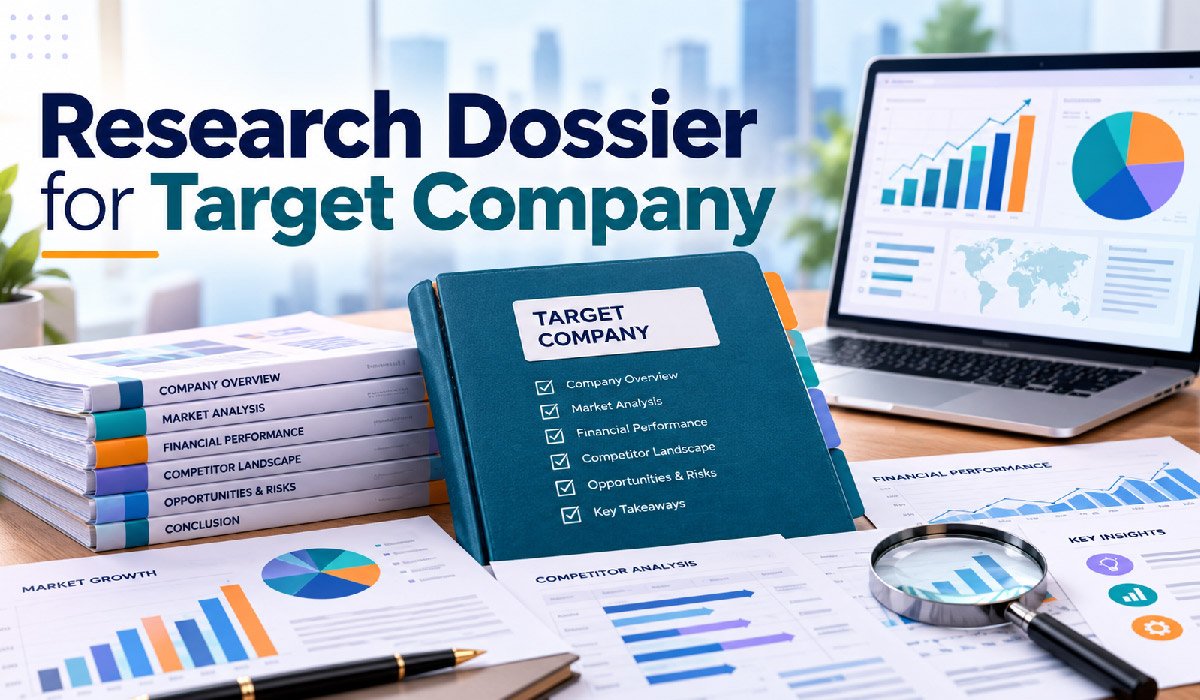
A research dossier for target company is a detailed report that collects important information about a business in one organized place. The target company simply means the business being studied. It can be a public company, private business, startup, manufacturer, retailer, technology company, or service provider.
The dossier usually covers the company’s identity, ownership, history, products, customers, leadership, financial position, competitors, operations, technology, legal matters, risks, and future opportunities. The purpose is not only to collect facts but also to explain what those facts may mean.
A useful research dossier also makes the limits of the research clear. Some information about private companies may not be available. Instead of guessing, the researcher should clearly identify what is confirmed, what is estimated, and what still needs to be checked. This makes the final report more reliable and useful for business decisions.
Why a Target Company Research Dossier Is Important
A target company research dossier helps people understand a business before making an important decision. Investors may use it to study financial health and growth potential. Buyers can use it before an acquisition, while suppliers may use company research to understand payment risk, stability, and long-term business demand.
Sales teams can also use a dossier before contacting an important prospect. Understanding the company’s products, leaders, customers, challenges, and recent developments can make business conversations more relevant. Competitor research teams may use the same information to understand market position and strategic changes.
The main value comes from having information organized in one place. Company information is normally spread across official websites, financial reports, government records, industry publications, and news sources. A structured dossier connects these details and helps the reader understand the wider picture rather than looking at isolated facts without context.
Start With a Clear Research Objective
Before researching a target company, decide exactly why the research is being completed. A clear objective helps prevent the dossier from becoming a large collection of information that does not support the final decision. Different research purposes require different types of company information.
An investor may focus on revenue, profits, debt, market growth, competition, and company value. A supplier may care more about financial stability, payment ability, customer demand, operations, and future contracts. A sales team may focus mainly on leadership, products, current priorities, business needs, and expansion plans.
The research should also have a clear scope. Decide which company, market, country, business unit, and time period will be covered. A research cutoff date should be included because company information changes over time. Defining the objective and scope at the beginning makes the research more focused, easier to verify, and more useful to the final reader.
Verify Company Identity, Ownership, and History
Correctly identifying the company is one of the first steps in building a research dossier. A brand name may be different from the official legal company name. Large business groups may also operate several subsidiaries, brands, and registered companies in different countries.
The dossier should confirm useful identity details such as the legal name, headquarters, official website, place of registration, parent company, subsidiaries, founders, and major owners when this information is available. Ownership may include individual founders, investment firms, public shareholders, parent corporations, or other business entities.
Company history provides additional context. Important events may include the founding date, early growth, funding rounds, acquisitions, major product launches, mergers, restructuring, international expansion, or leadership changes. The goal is not to include every event in the company’s history. It is better to focus on developments that explain how the company reached its current position and how its business changed over time.
Understand the Business Model and Revenue Sources
A strong research dossier should clearly explain how the target company makes money. Knowing what a business sells is useful, but understanding how money enters the company provides a much clearer picture of its business model and long-term stability.
Revenue may come from physical products, subscriptions, professional services, advertising, licensing, commissions, transaction fees, memberships, marketplace fees, or long-term contracts. Some companies use several revenue sources at the same time. The dossier should explain which sources appear most important when reliable information is available.
It is also useful to understand whether revenue is recurring or mainly based on one-time purchases. Recurring subscriptions and long-term contracts can create more predictable income, while individual purchases may depend more heavily on customer demand. Pricing structure, sales channels, distribution methods, and customer payment terms can also help explain how the business works and what factors may affect its financial performance.
Analyze Products, Services, and Customers
A target company dossier should explain the company’s main products and services in simple terms. Instead of copying promotional descriptions, the research should identify what customers actually buy, what problem the product solves, and how the offering fits into the company’s overall business model.
Customer research is equally important. Some businesses mainly sell to individual consumers, while others work with companies, governments, schools, hospitals, or other organizations. The dossier should explain the main customer groups and geographic markets when this information can be confirmed through reliable sources.
Customer concentration can create an important business risk. If a large percentage of revenue depends on one or two customers, losing one major contract could affect performance. Researchers should also look at why customers may choose the company, including price, service, technology, product quality, convenience, brand reputation, or contract terms. Understanding customers helps explain both current performance and future business potential.
Research Leadership, Employees, and Governance
Leadership can strongly influence a company’s strategy, culture, growth, and long-term direction. A research dossier should normally identify the founders, chief executive officer, senior managers, board members, and other important leaders who are relevant to the purpose of the research.
The information should always be checked for date and accuracy. Leadership can change quickly, and an old article may identify an executive who no longer works at the company. Major management changes can also be important when several senior leaders leave, join, or change roles within a short period.
Employee information can help show the size and structure of the business. Researchers may study workforce numbers, hiring activity, departments, locations, and employee growth when reliable information exists. Governance should also be considered. This includes board oversight, ownership control, succession planning, and dependence on one founder or executive. These factors can help readers understand how the company is managed and where leadership-related risks may exist.
Examine Financial Performance and Financial Health
Financial performance is one of the most important parts of many company research dossiers. Instead of looking at one figure, researchers should examine several reporting periods whenever possible. This helps show whether the company is improving, weakening, or experiencing major changes.
Useful financial information may include revenue, revenue growth, gross profit, operating expenses, profit margins, net income, losses, cash flow, cash reserves, capital spending, and debt. Revenue growth alone does not prove that a business is financially healthy. Costs may also be increasing, or the company may be using large amounts of cash.
The source of every financial number matters. Audited statements, annual reports, and regulatory filings generally provide stronger evidence than estimates from third-party websites. Private companies may publish very little financial information. In these cases, estimated figures should be clearly identified as estimates. Unknown financial information should remain unknown rather than being turned into unsupported claims.
Evaluate Market Position and Competitors
A company should be studied within the market where it actually operates. A business may have a strong position in a small specialist market while having very little influence across the wider industry. Understanding the correct market prevents misleading comparisons.
Research can include customer demand, market size, industry growth, geographic coverage, changing consumer behavior, regulations, technology trends, and other developments affecting the industry. These factors help explain whether the market itself is growing, becoming more competitive, or facing new challenges.
Competitor analysis should include both direct and indirect competitors. Direct competitors may sell similar products to similar customers, while indirect competitors may solve the same customer problem in a different way. Compare meaningful areas such as products, pricing, customer groups, technology, geographic reach, service quality, and distribution. Claims such as “market leader” or “number one” should be independently checked before being treated as confirmed facts.
Examine Operations, Technology, and Intellectual Property
A useful research dossier should explain how the target company operates behind the scenes. Depending on the business, operations may include manufacturing, suppliers, logistics, warehouses, vendors, distributors, technology platforms, contractors, or other partners that help the company deliver its products and services.
Dependency is especially important. A company that relies heavily on one supplier, factory, cloud provider, distributor, or technology partner could face problems if that relationship is interrupted. Researchers should also consider scalability, which describes whether the business can support more customers, orders, or locations as it grows.
Technology research may include software systems, automation, cybersecurity, research and development, data protection, and digital infrastructure. Intellectual property can include trademarks, patents, copyrighted material, proprietary software, designs, and other protected assets. Researchers should check ownership where possible because using a technology does not always mean the company owns it. Some systems may be licensed or provided by outside companies.
Review Legal, Regulatory, and Compliance Matters
Legal and regulatory research can reveal important issues that may affect the company’s operations, reputation, costs, or future plans. The first step is usually confirming the company’s official registration and any licenses required for its industry.
Depending on the business, researchers may examine lawsuits, regulatory actions, government investigations, patents, trademarks, employment matters, contracts, environmental rules, data protection requirements, or industry-specific regulations. A highly regulated business may face very different legal requirements from a simple online service company.
Legal research must be handled carefully. Not finding a lawsuit in one database does not prove that the company has never faced legal action. Researchers should explain what records were checked and when the search was completed. Laws and regulations also vary by country and industry. Complex legal issues may require professional legal advice, especially when the dossier is being used for an investment, acquisition, or major commercial agreement.
Identify Business Risks and Weaknesses
Every company faces risks, even when the business appears successful. A good research dossier should identify important risks supported by evidence rather than focusing only on positive company information. The importance of each risk depends on the company’s industry and business model.
Financial risks may include high debt, weak cash flow, falling profits, rising costs, or continuing losses. Operational risks can include supplier dependence, production problems, staff shortages, or system failures. Other risks may involve customer concentration, strong competitors, cybersecurity, regulations, lawsuits, outdated technology, or dependence on one important executive.
Researchers should distinguish between a risk and a confirmed problem. For example, dependence on one major customer creates customer concentration risk, but it does not prove that the customer will leave. The dossier should explain what evidence supports each risk, what the possible effect could be, and which additional information would help determine how serious the issue actually is.
Identify Growth Opportunities and Future Potential
Research should not focus only on problems. A target company dossier can also identify areas where the business may have room to grow. Opportunities may come from new products, growing customer demand, geographic expansion, partnerships, acquisitions, technology improvements, or new customer groups.
The quality of an opportunity depends on evidence. A company announcing plans to enter another country does not mean that expansion will automatically succeed. Researchers should consider market demand, competition, costs, regulation, customer behavior, and the company’s ability to carry out the plan.
Future potential should therefore be discussed carefully. The dossier may describe a market as an opportunity when there is evidence of growth or unmet demand, but it should avoid presenting future results as guaranteed. Comparing possible growth drivers with known business risks creates a more balanced view. This allows readers to understand both the positive possibilities and the practical challenges the target company may face.
Find Reliable Sources for Company Research
Reliable sources are essential because a research dossier is only as useful as the evidence supporting it. Official records should usually receive priority when they are available. These may include government business registers, annual reports, regulatory filings, court records, financial statements, and trademark or patent databases.
The company’s official website can provide information about leadership, products, locations, services, corporate announcements, and strategy. However, the company controls its own website, so promotional claims should not automatically be treated as independent facts. Important claims should be cross-checked when possible.
Established news organizations, industry publications, academic research, and reliable market reports can provide additional context. Researchers should always check publication dates because accurate information can become outdated. It is also useful to keep a source record showing where each important fact came from. Good source management makes the dossier easier to verify, update, and defend when someone questions a particular conclusion.
How to Research a Private Target Company
Private companies can be more difficult to research because they are usually not required to publish the same level of financial information as large public companies. This makes careful source checking especially important when preparing a dossier about a privately owned business.
Start with information that can be confirmed through company registration records, official websites, trademarks, patents, news reports, leadership profiles, funding announcements, and industry publications. Professional databases and business directories can also provide useful clues, although some of their financial or employee numbers may be estimates.
If direct access to the company is possible, researchers may request financial statements, debt information, customer details, major contracts, ownership documents, or other records relevant to the decision. Interviews with management can also provide useful information, but statements should be recorded with the person’s name, role, and date. When information cannot be verified, the correct approach is to state that limitation clearly instead of guessing.
Verify Information and Resolve Conflicting Sources
Company research often produces conflicting information. One source may report one revenue figure while another gives a different number. Leadership titles, employee counts, ownership information, and market estimates can also vary across different websites and reports.
Before deciding which figure is correct, check whether the sources cover the same company, year, currency, reporting period, and financial measure. One figure may refer to a parent company while another covers only a subsidiary. One source may report actual results while another provides an estimate.
The researcher should normally use the strongest available evidence rather than averaging conflicting figures. Official filings and audited financial statements generally carry more weight than unsourced third-party estimates. If a conflict cannot be resolved, explain that clearly in the dossier. Keeping confirmed facts, company claims, estimates, and independent analysis separate makes the document easier to understand and reduces the chance of presenting uncertain information as established fact.
Analyze the Information and Build the Final Dossier
Collecting information is only the first part of the research process. The next step is understanding what the information means. Look for trends, relationships, changes, strengths, weaknesses, and important dependencies rather than reading each fact in isolation.
For example, rising revenue may appear positive, but the result becomes more meaningful when compared with costs, profit margins, debt, cash flow, and customer concentration. Strong growth may be less attractive if most revenue depends on one customer or if the company is spending more cash every year.
The final dossier should bring these findings together in a logical order. Begin with the research objective and an executive summary, followed by company identity, ownership, business model, leadership, finances, customers, competitors, operations, technology, legal matters, risks, opportunities, and unanswered questions. The final assessment should directly answer the original research question and explain what further information may still be required.
Common Mistakes When Creating a Company Research Dossier
One common mistake is collecting information without deciding why it matters. A very long dossier can still be weak if most of its content does not help answer the original research question. Relevance is more valuable than simply increasing the number of pages.
Another mistake is treating marketing claims as confirmed facts. Companies naturally describe their products, growth, technology, and market position positively. Claims such as “industry leader,” “fastest-growing,” or “most trusted” should be checked through stronger evidence when they influence the final analysis.
Researchers should also avoid outdated information, unsupported financial estimates, incorrect company identities, and assumptions about missing data. Leadership, ownership, employee numbers, products, financial results, regulations, and competitors can all change. AI tools can help organize information, but important claims should still be checked against original sources. A reliable dossier clearly shows what is known, what is estimated, and what remains uncertain.
Keeping a Research Dossier Up to Date
A company research dossier should not be treated as permanently current. Business conditions can change quickly, especially in technology, finance, healthcare, retail, and other competitive industries. Every dossier should therefore include a clear research cutoff date.
Important changes may include new financial results, funding rounds, acquisitions, product launches, leadership changes, major customer contracts, lawsuits, regulatory actions, expansion plans, or changes in ownership. These developments can materially change an earlier assessment of the company.
The update schedule depends on the purpose of the research. A company being considered for an important transaction may require frequent checks, while a general market research dossier may only need periodic review. Historical information should not simply be deleted when the document is updated. Keeping dated records of major changes can help readers understand how the company has developed and whether earlier strengths, weaknesses, risks, or opportunities have changed over time.
Final Thoughts
A research dossier for target company turns scattered business information into a structured and useful picture of an organization. It can cover ownership, history, products, customers, leadership, finances, competitors, operations, technology, legal matters, risks, and possible growth opportunities.
The strongest dossiers do more than repeat information from different websites. They verify important facts, compare reliable sources, explain relevant trends, identify limitations, and clearly separate confirmed information from estimates, claims, and interpretation.
The goal is not to collect every available detail about a company. The goal is to collect the information that matters for the research objective and explain it clearly. When the research is organized, current, evidence-based, and easy to understand, a company dossier becomes a useful tool for investment research, partnerships, competitive analysis, sales preparation, acquisitions, and other important business decisions.
(FAQs)
What is a research dossier for target company?
A research dossier for target company is an organized report containing important information about a business. It may cover ownership, products, leadership, finances, competitors, customers, operations, risks, and other details needed for research.
Why is a target company research dossier important?
A target company research dossier helps people understand a business before making important decisions. It brings useful information together, highlights risks and opportunities, and helps investors, buyers, suppliers, researchers, and business teams make better decisions.
What should be included in a company research dossier?
A company research dossier should include business identity, ownership, history, products, customers, leadership, financial performance, competitors, market position, operations, technology, legal matters, risks, opportunities, and important unanswered questions.
How do you research a private target company?
Start with company registration records, official websites, trademarks, patents, reliable news reports, leadership information, funding announcements, and industry sources. Financial information may be limited, so estimates should be clearly separated from confirmed facts.
What are the best sources for target company research?
Reliable sources include government business registers, financial statements, annual reports, regulatory filings, official company websites, court records, trademark databases, patent records, established news publications, and trusted industry research reports.
Is a research dossier the same as due diligence?
No. A research dossier usually organizes available business information for analysis. Due diligence is often more detailed and may include private financial statements, contracts, tax records, legal documents, ownership records, and technical checks.
How often should a company research dossier be updated?
A company research dossier should be updated when important information changes. New financial results, leadership changes, acquisitions, funding, lawsuits, regulations, products, contracts, or ownership changes can make older research less accurate.
you may also read: Newslikeyou.com: Powerful Guide to Content, Services and Reliability









Discussion about this post