

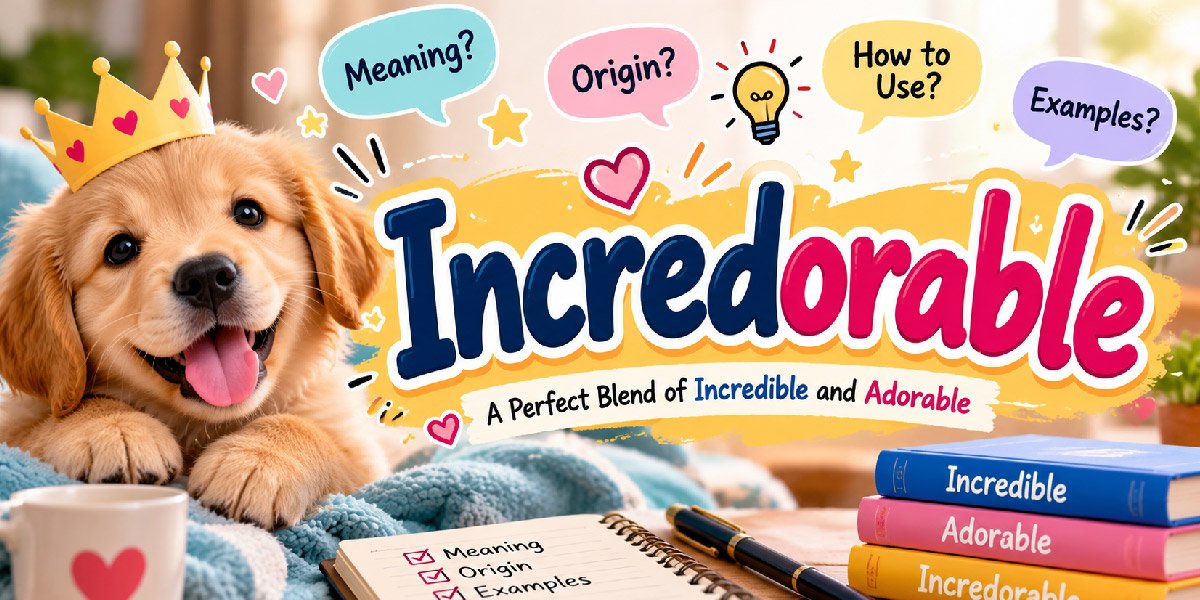
Incredorable is a playful expression used for something that feels incredibly adorable. It brings together the excitement of “incredible” and the warmth of “adorable,” making it useful when ordinary words such as cute, lovely, or amazing do not seem expressive enough.
You may see incredorable in social media captions, fan communities, comments, usernames, or other informal online spaces. Although it sounds like a natural English word, it is better understood as creative slang rather than a standard term used in formal writing or everyday professional communication.
In this article, we explore what incredorable means, how the word is formed, where it appears online, and how to use it naturally. We will also explain its connection with modern slang, word blending, pop culture, and the constantly changing language of the internet.
What Does Incredorable Mean?
Incredorable generally means “incredibly adorable.” It describes a person, animal, object, action, or moment that seems unusually lovable or charming. The expression adds extra emphasis, so it communicates a stronger reaction than simply saying that something is cute or adorable.
The meaning becomes clearer when we examine its apparent components. “Incredible” can describe something extraordinary, surprising, or unusually good, while “adorable” describes something lovable or charming. Combining these ideas produces an expression carrying both admiration and affection.
However, incredorable should not be treated as a formal synonym for incredible. Its online use is much narrower and more playful. A 2017 newspaper feature, for example, explicitly defined “incredorable” as “incredibly adorable,” showing that the expression existed well before its more recent search interest.
Is Incredorable a Real Word?
Whether incredorable is a “real word” depends on what real means. People have demonstrably used the expression, so it exists as an informal coined term. However, that does not automatically give it the same status as established standard-English words found in major dictionaries.
This distinction matters because internet language develops differently from formal vocabulary. People constantly invent expressions for jokes, captions, fandoms, memes, and conversations. A newly created term can communicate a recognizable idea even before dictionaries document it or before most English speakers know it.
Therefore, the most accurate description is that incredorable is an informal or playful coined expression. It can work perfectly well when the audience understands its intended meaning, but writers should avoid presenting it as a universally established English adjective with one official dictionary definition.
Where Does the Word Incredorable Come From?
The exact person who first created incredorable is difficult to establish from reliable public evidence. It would therefore be misleading to give the word a definite inventor or creation date. What can be confirmed is that documented public use goes back at least several years.
In May 2017, the Star Tribune featured “incredorable” in its “Word of the week” column and gave the meaning as “incredibly adorable.” That provides useful evidence that the expression was circulating long before the current wave of articles explaining it online.
The construction itself is easy to understand. It resembles a blend of “incredible” and “adorable,” with the two ideas compressed into one memorable expression. This makes the word intuitive even for someone encountering it for the first time, especially when it appears beside cute or heartwarming content.
Is Incredorable a Portmanteau Word?
Incredorable can reasonably be described as a creative word blend or portmanteau-style expression because its form and meaning suggest a combination of “incredible” and “adorable.” A portmanteau word combines elements and meanings from existing words to form something new.
English contains many established examples of this process. Collins describes a portmanteau word as a coined word combining two other words in both form and meaning, with “smog,” created from “smoke” and “fog,” being a classic example.
Incredorable follows a similar creative principle, although it does not have the same established status as famous blends such as smog. Its appeal comes from how easily readers can recognize the two positive ideas behind it without needing a long explanation of what the speaker feels.
What Is the Difference Between Incredorable, Incredible, and Adorable?
Incredible is an established adjective with several meanings. It can refer to something difficult to believe, or it can emphasize that something is unusually impressive or good. Cambridge, for example, documents both the “difficult to believe” sense and emphatic uses of the word.
Adorable has a different emotional focus. It describes someone or something that causes affection or liking, often because it appears attractive, charming, or sweet. That makes adorable especially common when discussing babies, pets, affectionate behavior, small objects, and other lovable things.
Incredorable combines these emotional territories informally. If a puppy is adorable, you find it lovable. If its behavior is incredible, you may find it remarkable. Calling the puppy incredorable playfully suggests that its charm is so strong that “adorable” alone does not express your reaction.
How Is Incredorable Used?
The easiest way to understand incredorable is through situations where someone feels both admiration and affection. Imagine a tiny puppy learning a clever trick. The trick may be impressive, while the puppy itself is extremely cute. Someone could playfully call the entire moment incredorable.
The same idea can apply to a child giving a thoughtful handmade present, a cat wearing an amusing costume, or an artist creating something both beautiful and charming. The speaker is not making a precise factual statement. Instead, the word communicates an enthusiastic emotional reaction.
Natural examples could include “That puppy is absolutely incredorable,” “Their matching outfits look incredorable,” or “What an incredorable moment.” These examples work because the context is relaxed and expressive. The unusual word itself becomes part of the humor, warmth, or enthusiasm of the message.
Where Should You Use Incredorable?
Social media is a natural home for a word like incredorable. Instagram captions, TikTok comments, short posts, private messages, fandom conversations, and casual chats encourage expressive vocabulary. In these settings, being playful can matter more than following formal writing conventions.
The expression can also work in creative marketing or entertainment writing when the intended voice is deliberately fun. A pet-related caption, cute-product campaign, entertainment post, or lighthearted headline might use a coined expression because unusual wording can attract attention and communicate personality quickly.
Context remains important. Some readers may immediately understand incredorable, while others may assume it is a typo. If clarity is essential, established alternatives such as “incredibly adorable,” “extremely cute,” “charming,” or “amazing and lovable” are safer choices and require no explanation.
Should Incredorable Be Used in Formal Writing?
Incredorable is generally better avoided in academic papers, formal reports, legal documents, professional applications, and other situations where standard vocabulary is expected. Creative slang can distract readers when the main goal is precision, credibility, or a neutral professional tone.
That does not make the expression incorrect in every situation. Register matters in language. Words that work beautifully between friends or in a humorous caption may sound unsuitable in a research paper. Skilled writers choose vocabulary according to their audience, purpose, and communication setting.
When writing formally, replace incredorable with the specific quality you actually mean. Use “remarkable” for something impressive, “adorable” for something lovable, “exceptional” for unusual quality, or “incredibly adorable” when you genuinely need to express both emphasis and affection in understandable language.
Why Do People Create Words Like Incredorable?
Existing vocabulary does not always capture exactly how people want to sound. Speakers therefore modify words, shorten them, combine them, and give old words new meanings. This creativity is a normal feature of living languages rather than something invented by social media.
Word blends are especially useful because they can package two familiar ideas into a compact expression. When the components are recognizable, readers may understand a newly coined word without previously learning its definition. Incredorable benefits from this kind of immediate linguistic familiarity.
There is also an emotional reason. Saying “adorable” communicates affection, but deliberately inventing or adopting a playful word can make the reaction feel more enthusiastic. The speaker is effectively saying that an ordinary adjective does not feel strong or entertaining enough for the moment.
How Social Media Helps Creative Words Spread
Digital platforms give informal language an enormous testing ground. People continuously publish captions, jokes, comments, memes, hashtags, and reactions. When an unusual expression feels memorable, other users can repeat it, adapt it, search for its meaning, or introduce it to another community.
Unlike traditional vocabulary development, this process does not require an editor or dictionary to approve a term first. Usage can come before formal recognition. A coined word may remain limited to a small community, suddenly receive wider attention, or disappear when people move to another expression.
This explains why search interest should not automatically be treated as proof that a term has become standard English. People may search for incredorable precisely because they do not recognize it. Online visibility tells us that a term is being encountered, not necessarily that it is universally accepted.
Incredorable in Fan Culture and Online Communities
Fandoms are particularly productive environments for expressive language. Fans often develop nicknames, abbreviations, inside jokes, hashtags, and exaggerated compliments. These expressions allow people to communicate not only information about an artist or character but also affection and membership within a community.
There is a concrete example connected with the word. “INCREDORABLE” has appeared as the name of a fan account associated with Stray Kids member Seungmin; a fan-maintained listing records an account using that name from 2023. This is evidence of one specific use, not proof that fandom created the word.
That distinction is important. The expression existed in documented public usage years earlier, including the 2017 newspaper example. Therefore, it is reasonable to discuss its later appearance in fan culture, but claims that K-pop or one particular community invented incredorable would go beyond the available evidence.
Why Is Incredorable Easy to Understand?
Incredorable benefits from familiar sound patterns. Even without a definition, an English speaker can notice its similarity to incredible and adorable. The surrounding context often does the rest. A caption under a cute animal photograph, for example, strongly suggests a positive and affectionate meaning.
This demonstrates an interesting feature of language comprehension. Readers do not interpret every word independently. They use spelling, recognizable word parts, sentence structure, surrounding images, previous knowledge, and context to infer what an unfamiliar expression probably means.
That does not guarantee that every reader will interpret incredorable identically. Someone unfamiliar with the expression might see it as a misspelling of incredible. For that reason, writers using it deliberately should provide enough context for the playful “incredibly adorable” meaning to become obvious.
Is Incredorable Just a Misspelling of Incredible?
Sometimes it could be. If a person writes “The company achieved incredorable results,” there is little connection with cuteness or affection. In that context, “incredible results” is probably what the writer intended, making incredorable more likely to be an error than deliberate slang.
The situation changes in a sentence such as “Look at those incredorable puppies.” Here, the combination of a playful word and an obviously cute subject makes the “incredibly adorable” interpretation much more natural. Meaning therefore depends heavily on the context surrounding the unusual spelling.
This is one reason definitions of emerging internet terms should avoid being overly rigid. The same string of letters can function as deliberate wordplay, a username, a brand name, or a typing error. Readers should examine how the term is actually being used before assigning a meaning.
Can Incredorable Become a Standard English Word?
It is possible for newly coined expressions to become established, but no one can reliably predict which ones will survive. A term normally needs sustained and widespread use before it becomes familiar enough that readers no longer need an explanation when they encounter it.
Some word blends have become completely ordinary. Others remain jokes, niche expressions, brand names, or short-lived trends. Being clever or understandable is not enough by itself. Communities must continue using a term across time and in enough different situations for its linguistic reach to expand.
For now, incredorable is best treated as playful informal language rather than necessary standard vocabulary. Its future depends on actual usage. If speakers keep finding it useful, its visibility may grow. If they move to other expressions, it may remain an interesting example of creative word formation.
What Incredorable Tells Us About Modern English
Incredorable illustrates how flexible English can be. Speakers do not simply select words from a fixed list. They also experiment with sounds and meanings, producing new expressions that suit particular emotions, communities, jokes, trends, and communication styles.
The internet makes this creativity much easier to observe. A playful expression can move from one conversation to public posts and search results very quickly. At the same time, online repetition can make a rare term appear more established than it actually is.
The useful lesson is to separate usage from formal status. Incredorable has been used as an expression, and its intended “incredibly adorable” meaning is understandable. However, writers should still recognize the difference between playful slang and established vocabulary when deciding where and how to use it.
Final Thoughts
Incredorable is a playful way of expressing the idea that something is incredibly adorable or combines impressive qualities with irresistible charm. Its apparent blending of familiar words makes the meaning easy to guess, which helps explain why it works effectively in casual and creative communication.
The expression is especially suitable for pets, sweet gestures, cute outfits, heartwarming moments, fandom posts, and other positive situations. However, it is not a good replacement for precise standard vocabulary when writing academic, professional, technical, or other formal material.
Most importantly, incredorable demonstrates how language grows through experimentation. People continuously reshape familiar vocabulary to express emotion in memorable ways. Whether this particular expression becomes more widespread or remains niche, it offers a simple example of creativity at work in modern English.
(FAQs)
What does Incredorable mean?
Incredorable is a playful expression generally used to mean “incredibly adorable.” It describes something exceptionally cute, charming, lovable, or both impressive and adorable.
Is Incredorable a real word?
Incredorable has been used informally, but it is not generally treated like a standard formal English word. It is better understood as a creative or slang expression.
Is Incredorable a combination of incredible and adorable?
Yes. Incredorable is commonly understood as a creative blend of incredible and adorable, combining the positive meanings of both words into one expression.
How do you use Incredorable in a sentence?
You could say, “That puppy looks absolutely incredorable,” or “Her reaction was incredorable.” It works best in casual conversations, captions, comments, and other informal writing.
Is Incredorable the same as incredible?
No. Incredible usually means extraordinary, amazing, or difficult to believe. Incredorable adds the idea of being adorable, lovable, or charming to that sense of strong admiration.
Where is the word Incredorable used?
Incredorable can appear in social media posts, captions, fan communities, comments, usernames, and casual conversations. Its playful nature makes it more suitable for informal communication.
Can Incredorable be used in formal writing?
It is usually better to avoid Incredorable in academic, business, legal, or other formal writing. Depending on the intended meaning, use established words such as adorable, incredible, charming, remarkable, or incredibly adorable instead.
you may also read: What Is Gayfirir? Meaning, Origin and Online Uses Explained









Discussion about this post