

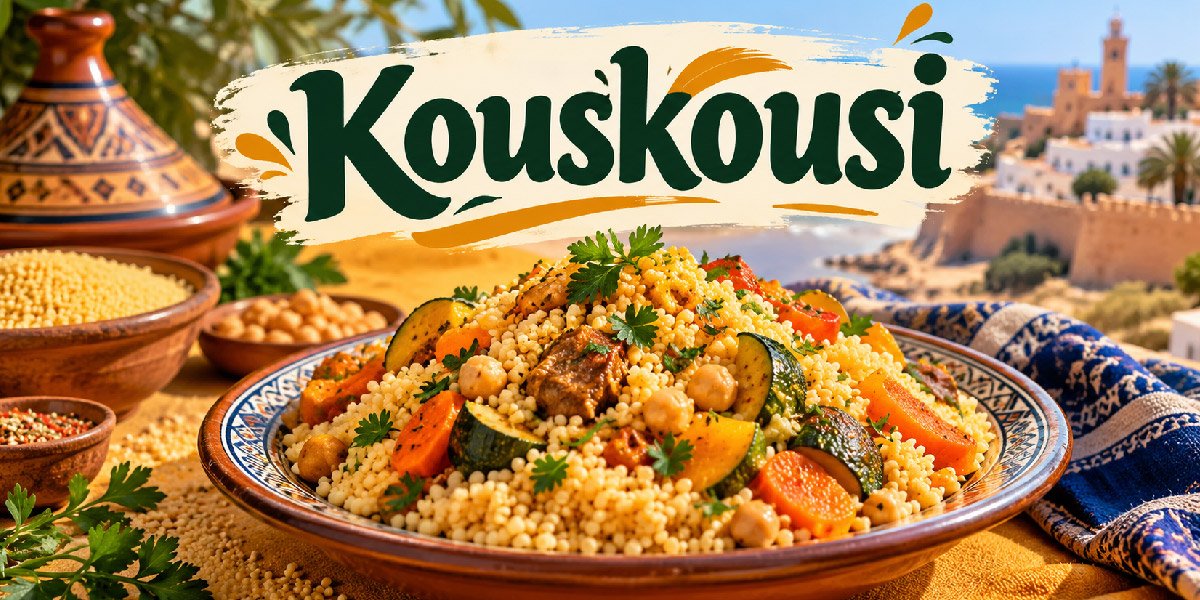
Kouskousi is a food term that attracts attention because its meaning is not always clear. It is commonly connected with couscous, the famous North African food made from tiny semolina granules, although similar-sounding names are also found in other Mediterranean cuisines.
Understanding Kouskousi therefore requires more than looking at its appearance. Traditional couscous has a long cultural history, a special preparation method, and many regional variations. It can be served with vegetables, chickpeas, meat, fish, broth, herbs, and spices, depending on local traditions.
This guide explains what Kouskousi means, its connection with couscous, where the food comes from, how it is traditionally prepared, its cultural importance, nutrition, cooking methods, serving ideas, and the differences between similar foods.
What Is Kouskousi?
Kouskousi is generally encountered as a spelling or food term associated with couscous and similar small wheat products. Traditional couscous consists of tiny granules normally produced from durum wheat semolina. Although the finished pieces resemble grains, couscous is not a naturally occurring cereal grain like rice.
The granules are traditionally created by gradually moistening semolina and working it until small particles form. They are separated according to size and can then be dried. Traditional preparation cooks these granules with steam, producing the soft and separate texture associated with properly prepared couscous.
However, shoppers should not identify an unfamiliar product from the word Kouskousi alone. A similar Greek name, kouskousaki, refers to pasta. Ingredients and package directions provide the clearest answer because couscous and small pasta can require significantly different cooking methods.
Is Kouskousi the Same as Couscous?
When Kouskousi is being used to describe North African semolina couscous, the food is essentially connected with the broader couscous tradition. Spellings and pronunciations of couscous have varied across languages and communities, so encountering different forms of the name is not unusual.
What matters more than spelling is the product itself. Traditional couscous is produced by forming semolina into small granules rather than making a conventional kneaded pasta dough. Historically, these granules have been steamed, often above a flavorful broth or stew.
The name should nevertheless be treated carefully. Greek kouskousaki belongs to a traditional pasta family and should not automatically be described as North African couscous. When buying Kouskousi, checking its ingredients, origin, product description, and preparation directions prevents this naming confusion.
Where Does Kouskousi Come From?
Couscous has deep roots in North Africa and is particularly associated with the Maghreb. Its history extends back centuries, although assigning one exact birthplace and date is difficult. Historical evidence connects couscous strongly with the Indigenous Amazigh, or Berber, cultures of North Africa.
The food later spread across communities and regions, developing different recipes along the way. It became important in Algeria, Morocco, Tunisia, Mauritania and other areas. Its history demonstrates why couscous is better understood as a broad culinary tradition rather than one standardized modern recipe.
Migration and trade eventually carried couscous much farther. Today it can be found throughout Europe and in supermarkets and restaurants around the world. Industrial production has made preparation much faster, but traditional hand-forming and steaming remain important parts of understanding its cultural background.
Why UNESCO Recognizes Couscous Traditions
In 2020, UNESCO inscribed the knowledge, know-how and practices related to producing and consuming couscous on its Representative List of the Intangible Cultural Heritage of Humanity. Algeria, Mauritania, Morocco, and Tunisia jointly presented the multinational nomination.
The recognition concerns much more than the food sitting on a plate. It includes preparation methods, manufacturing conditions, traditional tools, associated objects, consumption practices, and the knowledge communities have developed and transmitted while making and sharing couscous.
This distinction is important when discussing Kouskousi. UNESCO did not declare a single modern recipe to be the only correct version. Instead, the inscription highlights living knowledge and cultural practices shared across communities, showing that couscous has social importance beyond being an everyday source of food.
What Is Kouskousi Made From?
Traditional wheat couscous is generally made with semolina, which comes from durum wheat. Water is introduced gradually during production so the semolina forms tiny granules. The traditional process differs from simply cutting or extruding ordinary pasta dough into small shapes.
Commercial production can reproduce this process on a much larger scale. Many supermarket varieties are also pre-steamed and dried before packaging. This treatment explains why modern instant couscous can become tender after only a short period in hot water or broth.
Consumers should still read the ingredient list because products differ. Whole-wheat varieties are available, while alternative products may use other ingredients. Anyone managing wheat allergies, celiac disease, or another dietary restriction should never assume a product is suitable simply because its pieces look like couscous.
How Traditional Kouskousi Is Prepared
Traditional couscous preparation requires more time than preparing an instant supermarket product. Semolina is gradually moistened and worked to produce small, reasonably even granules. The couscous can be dried for storage before later being prepared as part of a meal.
Cooking traditionally relies on steam. A couscoussier is a two-level cooking vessel associated with this method. A broth or stew can cook below while couscous sits in the perforated upper section, where rising steam gradually cooks and softens the granules.
Cooks may steam couscous repeatedly, separating and working the granules between steaming stages. The purpose is to create couscous that feels tender and light rather than dense or sticky. This careful process helps explain why traditional preparation is considered a culinary skill rather than simple boiling.
How to Cook Instant Kouskousi
Modern instant couscous is much easier to prepare because manufacturers have already steamed and dried it. Usually, a measured amount of hot water or broth is added to the couscous. The container is then covered so the granules can absorb moisture.
After several minutes, the couscous can be uncovered and gently separated with a fork. Exact liquid ratios and resting times differ among products, so the package instructions should take priority over a universal recipe found online.
Flavor can be added without making preparation complicated. Vegetable or chicken broth can replace water, while olive oil, herbs, lemon, pepper, vegetables, or suitable spices can be added afterward. The goal is moist, tender granules that remain separate rather than becoming a wet mass.
Kouskousi and Greek Kouskousaki Are Different
One of the most useful distinctions for readers searching for Kouskousi concerns Greek kouskousaki. Greece has a long tradition of small pasta shapes, and kouskousaki is recognized as one of these traditional pasta varieties. Its similar name can easily cause confusion online.
Greek pasta may contain wheat and, depending on the variety or recipe, ingredients such as milk or eggs. It is prepared as pasta and can appear in soups, salads, meat dishes, seafood recipes, and other meals. It should not automatically be classified as couscous.
The practical difference becomes especially important in the kitchen. Instant couscous commonly absorbs measured hot liquid while resting. Pasta generally needs active cooking in boiling liquid. Following couscous instructions for pasta—or pasta instructions for instant couscous—can produce disappointing texture, so always identify the product first.
What Does Kouskousi Taste Like?
Plain couscous has a mild wheat flavor rather than a powerful taste of its own. This neutral character is one of its strengths because it allows sauces, broth, herbs, spices, vegetables, meat, and other ingredients to provide most of the meal’s flavor.
Texture is equally important. Well-prepared couscous should be tender and relatively light, with granules that can be separated instead of forming one sticky mass. Traditional steaming is particularly valued because it gives cooks greater control over moisture and texture.
Its mild character also makes couscous adaptable beyond traditional recipes. Lemon and fresh herbs can create a lighter dish, while a strongly seasoned vegetable or meat broth produces something richer. Rather than dominating a recipe, Kouskousi can carry the flavors served alongside it.
Popular Ways to Serve Kouskousi
One classic approach is to serve couscous with vegetables and flavorful broth. Chickpeas can provide additional substance, while lamb, chicken, or other meats may be included according to the regional recipe, household preferences, availability, and occasion.
Fish and seafood also appear in couscous traditions, particularly in areas where local cuisine reflects access to the sea. Vegetarian versions can combine the couscous with chickpeas, lentils, squash, carrots, tomatoes, zucchini, peppers, onions, or other seasonal produce.
Modern cooks also use couscous in cold or room-temperature salads. Herbs, lemon, vegetables, nuts, dried fruit, or legumes can be combined with it. These newer applications demonstrate its flexibility, although they should not be confused with every region’s traditional way of serving couscous.
Regional Kouskousi Traditions
There is no single recipe that represents all North African couscous. Geography, household traditions, available produce, religious customs, and local tastes have created considerable variation. Even two families from the same country may prepare and season their couscous differently.
Moroccan preparations may feature combinations of vegetables, chickpeas, meat, broth, and aromatic spices. Algerian traditions likewise include many regional versions using different vegetables and meats. Tunisian preparations can feature stronger heat and may incorporate ingredients such as harissa, depending on the particular dish.
Mauritania also formed part of the joint UNESCO couscous nomination, an important reminder that the cultural geography of couscous is wider than the countries most commonly represented on international restaurant menus. These differences should be appreciated instead of forcing every preparation into one supposed “authentic” formula.
Is Kouskousi Healthy?
Couscous mainly supplies carbohydrates because its primary ingredient is wheat semolina. It also provides protein and various micronutrients, although exact nutritional values depend on the product, serving size, processing method, and any ingredients added to the finished meal.
Whole-wheat couscous can provide more dietary fiber than more refined alternatives. However, judging an entire meal only by its couscous is misleading. Vegetables, beans, lentils, fish, meat, oils, sauces, and serving sizes can substantially change the meal’s overall nutritional profile.
Kouskousi therefore does not need to be promoted as a miracle or “superfood.” It can simply form part of a balanced diet. Combining an appropriate portion with vegetables and a suitable protein source can produce a more nutritionally complete meal than eating plain couscous alone.
Does Kouskousi Contain Gluten?
Standard couscous made from durum wheat semolina contains gluten. This means conventional wheat-based Kouskousi is generally unsuitable for someone who must strictly avoid gluten because of celiac disease or another medically diagnosed gluten-related condition.
Products marketed as gluten-free couscous alternatives also exist. They can be made from ingredients other than wheat, but their appearance does not make them traditional durum-wheat couscous. A clear gluten-free label is important when dietary safety is involved.
The same caution applies to Greek kouskousaki. Traditional Greek pasta is normally wheat-based and can contain additional ingredients depending on the recipe. People with allergies or dietary restrictions should check the complete ingredient and allergen statements rather than relying on a food’s name or appearance.
Kouskousi Compared With Rice and Quinoa
Couscous, rice, and quinoa can perform similar jobs on a plate, but botanically and technically they are different foods. Rice is a cereal grain, while quinoa is a seed commonly prepared and eaten in a grain-like manner.
Couscous is a manufactured semolina product. Its small granules are formed from wheat material and traditionally steamed. Consequently, conventional couscous contains gluten, whereas plain rice and quinoa are naturally gluten-free, provided they have not been contaminated or combined with gluten-containing ingredients.
Their textures and cooking methods also differ. Instant couscous can be extremely fast to prepare, while rice and quinoa normally require longer cooking. Choosing between them depends on dietary requirements, flavor, texture, preparation time, availability, and the other ingredients in the meal.
Common Kouskousi Cooking Mistakes
Using too much liquid is a common problem with instant couscous. Excess water can leave it heavy or soggy instead of fluffy. Measuring according to the manufacturer’s instructions is safer because different grain sizes and products may require different amounts.
Another mistake is treating every tiny wheat product as couscous. Greek kouskousaki and other small pasta shapes may resemble couscous but require boiling. Identifying the product before cooking prevents both undercooked pasta and overhydrated couscous.
Finally, cooks sometimes overlook seasoning because couscous looks finished once it has absorbed its liquid. Its mild flavor benefits from a well-seasoned broth or complementary ingredients. After resting, gently fluffing it with a fork can also improve separation without unnecessarily crushing or compacting the granules.
How to Store Kouskousi
Uncooked dried couscous should be kept according to its package directions, normally in a cool and dry location. After opening, closing the original package securely or transferring the product to a suitable sealed food container can help protect it from moisture.
Cooked couscous is perishable and should be handled using normal food-safety practices. Refrigerate leftovers promptly rather than leaving them sitting at room temperature for extended periods. Storage life can depend on what else is mixed into the dish, particularly meat or seafood.
When reheating, a little moisture can help if the couscous has dried out in the refrigerator. Add a small amount of water or broth and heat it thoroughly. Leftover couscous can also work in cold dishes when it has been cooked, cooled, and stored safely.
How to Buy the Right Kouskousi
Start with the ingredient list rather than relying entirely on the product name. If the package contains durum wheat semolina and identifies itself as couscous, examine whether it is instant, pre-cooked, medium, fine, or another type requiring a particular preparation method.
Next, read the cooking directions. Instructions telling you to add measured hot liquid and rest usually indicate a quick-cooking couscous product. Directions requiring sustained boiling can indicate pasta or another product, even when its appearance resembles tiny couscous grains.
Finally, check allergen information, country of origin, serving suggestions, and storage directions. Whole-wheat options may appeal to people seeking additional fiber. Most importantly, shoppers encountering the word Kouskousi should identify exactly what is inside the package instead of assuming every similarly named product is identical.
Why Kouskousi Has Cultural Importance
Couscous is more than a convenient carbohydrate. UNESCO’s recognition specifically covers knowledge, skills, preparation methods, tools, and circumstances of consumption. That broader definition reflects how food practices can transmit cultural knowledge between families and generations.
Preparing and eating couscous can accompany ordinary meals as well as social and ceremonial occasions. The exact customs vary between communities, but sharing food can connect hospitality, family relationships, agricultural knowledge, cooking skills, and collective memory.
Global popularity does not reduce this cultural importance. Instead, it gives food writers, restaurants, and consumers a reason to describe its background accurately. Appreciating Kouskousi means enjoying the food while also recognizing the North African traditions that developed and preserved couscous practices over generations.
Final Thoughts
Kouskousi is best understood by looking beyond its small size and simple appearance. When the term refers to couscous, it connects with a centuries-old North African culinary tradition built around semolina, careful granule formation, steaming, flavorful accompaniments, and shared meals.
At the same time, names matter. Similar words such as Greek kouskousaki can identify a different wheat product with a pasta-style preparation. Checking ingredients and cooking directions is therefore the easiest way to determine exactly what you are buying or preparing.
Whether served with vegetables, chickpeas, chicken, lamb, fish, broth, or fresh herbs, couscous remains remarkably adaptable. Its continuing popularity comes from this versatility, but its cultural history deserves equal attention. Understanding both sides makes Kouskousi more meaningful than simply treating it as another quick side dish.
(FAQs)
What is Kouskousi?
Kouskousi is a term commonly encountered in connection with couscous or similar small wheat foods. When referring to traditional couscous, it describes tiny granules usually produced from durum wheat semolina and traditionally cooked using steam.
Is Kouskousi the same as couscous?
The term may be used in connection with couscous, but spelling alone is not enough to identify a product. The similarly named Greek kouskousaki is a form of pasta. Always check the ingredients and cooking instructions.
Where does Kouskousi come from?
Couscous has deep historical and cultural roots in North Africa, particularly the Maghreb. Algeria, Mauritania, Morocco, and Tunisia jointly nominated couscous-related knowledge and practices for UNESCO recognition, which was granted in 2020.
What is Kouskousi made from?
Traditional couscous is generally made from durum wheat semolina and water. The semolina is worked into tiny granules that can be dried and traditionally steamed. Commercial instant varieties are commonly pre-steamed and dried for faster preparation.
Is Kouskousi gluten-free?
Traditional Kouskousi or couscous made from durum wheat is not gluten-free. People who need to avoid gluten should choose a product specifically labeled gluten-free and check its complete ingredient and allergen information before eating it.
How do you cook Kouskousi?
The method depends on the product. Traditional couscous is steamed, while many instant varieties only require measured hot water or broth followed by a short resting period. Greek pasta-style kouskousaki generally requires boiling, so package directions should always be checked.
you may also read: Tatavel Explained: Travel Guides, Hotels, Tips & More









Discussion about this post