

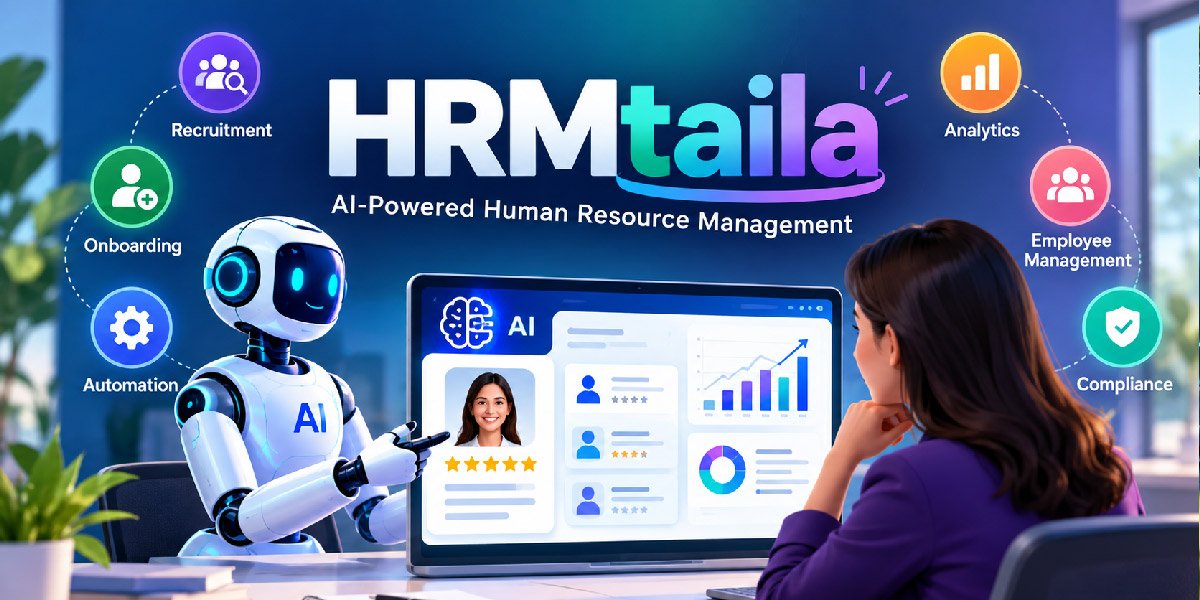
HRMtaila is an emerging term connected with artificial intelligence, automation, and modern human resource management. It appears in online discussions about how businesses can use technology to manage recruitment, employees, workplace data, training, and routine HR administration more efficiently.
The important distinction is that HRMtaila should not automatically be treated as the name of an established commercial HR platform. Public information does not clearly establish a specific company, developer, product suite, or official technical standard behind the term. It is more useful to understand HRMtaila in the broader context of AI-assisted HR management.
That wider concept is increasingly relevant. HR departments manage large amounts of information while supporting employees throughout their working lives. AI can assist with repetitive processes, organize data, and surface useful insights. However, employment decisions can significantly affect people, making human judgment, privacy, transparency, and fairness essential.
What Is HRMtaila?
HRMtaila can be described as an emerging online term associated with using AI and digital automation in human resource management. In this context, it covers technologies that assist HR teams with administrative processes, employee services, recruitment, analytics, training, and workforce planning.
The term does not currently have a single authoritative definition that businesses universally follow. It should therefore not be confused with established categories such as a Human Resource Information System (HRIS), Human Resource Management System (HRMS), or Human Capital Management (HCM) platform.
A practical way to understand HRMtaila is as a label for the intersection of HR and AI. Technologies in this area can process information, automate workflows, identify patterns, generate content, and assist employees, while HR professionals remain responsible for appropriate oversight and important decisions.
Is HRMtaila an Actual Software Platform?
HRMtaila is sometimes described online in ways that make it sound like a complete software platform. However, detailed product claims require caution. A legitimate commercial HR platform would normally provide identifiable information about its company, services, documentation, pricing, integrations, security practices, or customer support.
Without reliable primary information establishing those details, features should not be presented as confirmed HRMtaila product capabilities. Recruitment automation, HR chatbots, workforce analytics, and digital onboarding are real technologies, but their existence does not prove that a particular HRMtaila application provides them.
This difference matters for readers researching the keyword. HRMtaila is currently better explained through the technologies and HR practices associated with it rather than through unsupported claims about a specific product. Any future platform making that name official should be evaluated using its own documentation.
How AI Fits Into Modern Human Resources
Artificial intelligence can process information at a scale that would take employees considerable time to handle manually. Within HR, it may classify information, summarize documents, identify patterns, generate routine content, or help users retrieve information from approved company resources.
Automation works alongside AI but is not exactly the same thing. A workflow might automatically send an onboarding reminder when a deadline approaches without requiring AI. More advanced systems can use AI to interpret questions, analyze unstructured information, or assist users with more complex tasks.
Combining these technologies can reduce repetitive administration. The purpose should not simply be to automate as much HR work as possible. Organizations gain more value when technology handles suitable routine processes while HR professionals devote additional attention to employee relations, organizational development, strategy, and complex decisions.
HRMtaila and Recruitment
Recruitment involves several repetitive activities, making it a common area for automation. Hiring teams may need to organize applications, communicate with candidates, coordinate calendars, maintain records, prepare job-related content, and move applicants through different stages of the recruitment process.
AI-assisted tools can help extract information from resumes, identify relevant skills, summarize applications, draft job descriptions, or support candidate searches. Scheduling systems can reduce lengthy email exchanges by finding interview times and automatically providing candidates with necessary meeting information.
Recruitment automation also requires careful oversight. A candidate cannot always be accurately evaluated from keywords, historical patterns, or automated scores. Organizations should examine whether hiring technology produces unfair outcomes and maintain meaningful human involvement, particularly when automated recommendations influence employment opportunities.
Making Employee Onboarding More Organized
A new employee often needs to complete many tasks before becoming fully productive. These may include providing employment documents, receiving system access, reading workplace policies, enrolling in benefits, completing mandatory training, and meeting managers or team members.
Digital workflows can organize these activities into a structured onboarding journey. Employees can receive relevant tasks at appropriate times, while HR teams can monitor completion and identify missing requirements. Automated reminders can reduce the need for HR staff to manually follow up on every step.
AI assistants can complement these workflows by helping new employees locate information or understand routine procedures. Technology, however, cannot replace a supportive manager or welcoming team. Effective onboarding combines efficient digital administration with introductions, conversations, feedback, role clarity, and genuine human support.
Employee Self-Service and AI Assistants
Many HR departments repeatedly receive similar questions. Employees may need information about annual leave, workplace policies, benefits, payroll schedules, internal forms, training requirements, or procedures for updating personal information. Answering every routine question manually can consume significant HR time.
Employee self-service systems make common information available without requiring an HR representative for every request. AI assistants can extend this model by allowing employees to ask questions conversationally and receive answers based on approved policies, documents, and organizational knowledge.
There must still be a straightforward route to human assistance. Complaints, discrimination concerns, workplace conflicts, complicated compensation problems, accommodations, disciplinary matters, and other sensitive situations require careful handling. An AI assistant should recognize its limitations and escalate appropriate issues rather than pretending to resolve them.
Workforce Analytics and Better Planning
Workforce analytics involves studying employee and organizational data to understand patterns and support decisions. Useful measures can include headcount, employee turnover, hiring time, absenteeism, labor costs, internal mobility, training completion, skills, and staffing requirements across different departments.
AI can help analysts examine large datasets and identify relationships that may otherwise be difficult to notice. Organizations might discover a persistent skills shortage, unusually long recruitment times for certain positions, or workforce capacity that is not keeping pace with business demand.
Patterns require interpretation before action is taken. High turnover, for example, does not automatically reveal why employees are leaving. Compensation, management quality, workload, career development, scheduling, or organizational change could contribute. Analytics can identify where investigation is needed, while conversations and further evidence explain what is actually happening.
HRMtaila and Employee Training
Workplace skills change as organizations introduce new technologies, products, regulations, and working methods. HR and learning teams consequently need ways to identify skill gaps, provide relevant development opportunities, and monitor whether required training has been successfully completed.
AI-supported learning systems can recommend educational content using information such as an employee’s role, existing skills, development objectives, or previous learning activity. Automation can also distribute courses, remind employees about deadlines, record completion, and help managers monitor required training.
Personalization can make learning more relevant, but recommendations need thoughtful design. Employees should not be restricted by assumptions generated from historical data. Managers and employees should be able to discuss development goals and explore opportunities beyond whatever an algorithm initially recommends.
Payroll, Leave, and HR Administration
Administrative accuracy is essential because HR information can affect employee pay, benefits, leave, and employment records. Repeatedly entering the same information into disconnected systems increases workload and creates opportunities for inconsistencies or human error.
Integrated HR systems can move approved information between relevant processes. Attendance, approved leave, overtime, or employee changes may feed into payroll workflows where appropriate. Automation can also flag incomplete records, unusual entries, upcoming deadlines, or transactions requiring additional review.
Automation reduces repetitive work but does not guarantee correct outcomes. A mistake in source data can travel through connected systems quickly. Organizations therefore need validation rules, access controls, approval processes, audit trails, and human review for exceptions or changes with significant consequences for employees.
AI in Performance Management
Performance management involves more than giving employees a numerical rating. Managers may consider objectives, completed work, feedback, responsibilities, collaboration, development, changing business conditions, and other evidence when discussing an employee’s contribution and future growth.
AI can help organize information used during these discussions. It may summarize feedback, highlight progress against documented objectives, or identify possible learning needs. This can reduce administrative preparation and give managers a more structured starting point for performance conversations.
Automated evaluation can become problematic when incomplete metrics are treated as a complete picture of performance. Some valuable contributions are difficult to quantify. Important decisions involving compensation, promotion, disciplinary action, or continued employment should therefore include qualified human judgment and appropriate organizational procedures.
Key Benefits of AI-Powered HR
One major advantage of HR automation is efficiency. Routine workflows, reminders, information retrieval, reporting, and administrative processes can require substantial staff time. Automating appropriate parts of this work can allow HR professionals to spend more time on higher-value responsibilities.
Consistency is another potential advantage. Structured workflows can help organizations follow required onboarding, documentation, training, and approval steps more reliably. Digital records can also make processes easier to monitor, provided the underlying system is properly configured and maintained.
AI can further improve access to information and support analysis. Employees may receive quicker answers to routine questions, while HR leaders can examine workforce patterns more effectively. These benefits depend on data quality, system design, security, employee adoption, and responsible implementation rather than AI alone.
Important Risks and Limitations
AI systems are not automatically accurate simply because they process large amounts of data. They can misunderstand information, generate incorrect responses, rely on incomplete inputs, or produce recommendations that appear convincing despite being unsuitable for a particular workplace situation.
Another limitation is context. Employment situations frequently involve circumstances that cannot be captured fully in structured data. An attendance pattern, performance metric, or employee survey score may show what happened without explaining the personal or organizational factors responsible for it.
Overreliance on automated outputs can therefore create significant problems. Organizations need defined boundaries describing which tasks can be automated, which recommendations require verification, and which decisions require human involvement. Employees should also know where to report errors and obtain assistance when technology fails.
Bias and Fairness in HR Technology
Bias is particularly important when AI influences employment decisions. Systems trained on historical information may reproduce patterns contained within that information. A model can also generate unfair outcomes because of inappropriate variables, incomplete data, poor design, or the way its results are used.
Organizations should evaluate HR technologies before relying on them for high-impact decisions. Testing should examine whether results are accurate, relevant, and fair across appropriate groups. Systems should continue to be monitored after implementation because data, workplace conditions, and technology can change.
Human oversight remains necessary, but simply adding a person does not automatically eliminate bias. Reviewers need suitable information, authority, and training to challenge automated recommendations. Clear accountability is essential so organizations know who is responsible when technology contributes to an employment decision.
Protecting Employee Data and Privacy
HR departments handle information that can be highly sensitive. Depending on the organization and jurisdiction, records may contain contact information, compensation, employment history, performance information, identification details, benefits data, attendance records, job applications, and other personal information.
Introducing AI creates additional questions about how this information is processed. Employers should understand what data a system collects, why it needs that data, where information is stored, who can access it, how long it is retained, and whether external providers process it.
Security controls should reflect the sensitivity of the information involved. Access restrictions, authentication, encryption where appropriate, monitoring, vendor assessment, and data governance all play a role. Organizations must also consider applicable privacy, employment, and AI-related legal requirements in the jurisdictions where they operate.
How Businesses Can Adopt HR AI Responsibly
Businesses can begin by identifying a specific problem rather than buying technology simply because it uses AI. A company struggling with interview coordination, for example, may benefit more from improving scheduling than immediately attempting to automate its entire recruitment process.
A limited pilot can then test accuracy, usability, security, employee experience, and actual time savings. HR teams should record errors and exceptions rather than focusing only on successful cases. Results can help determine whether the technology should be expanded, modified, or discontinued.
Governance should grow alongside adoption. Organizations need clear responsibilities, data controls, escalation procedures, employee communication, and regular reviews. High-impact applications may also require cooperation among HR, legal, privacy, security, IT, management, and other specialists before deployment.
HRMtaila vs Traditional HR Management
Traditional HR often relies heavily on employees completing administrative work themselves. Applications may be reviewed manually, onboarding reminders sent individually, reports assembled from spreadsheets, and routine employee questions answered repeatedly through email or face-to-face communication.
An AI-assisted model shifts suitable activities toward automated workflows and self-service. Software can organize records, trigger routine actions, help retrieve information, and support analysis. HR professionals can then concentrate more heavily on employee relations, organizational planning, difficult cases, and strategic priorities.
The strongest approach is not necessarily traditional HR or maximum automation. Effective HR combines reliable technology with skilled professionals. Machines are useful for processing, consistency, and scale, while people contribute context, empathy, accountability, negotiation, communication, and judgment that employment decisions frequently require.
Why Human Oversight Remains Essential
Employment decisions can affect a person’s income, career, opportunities, and daily life. That makes HR different from many low-risk automation use cases. Efficiency is valuable, but it should not come at the expense of fair processes or appropriate accountability.
Human oversight is particularly important for recruitment decisions, compensation, promotions, performance actions, workplace complaints, disciplinary procedures, and termination. The exact level of oversight will depend on the decision, technology, organizational policy, and legal requirements involved.
Employees also need practical ways to challenge errors or request human assistance. A responsible HR system should not trap workers inside an automated process. Technology works best when it handles suitable administrative burdens while qualified people remain accessible for exceptions, disputes, sensitive concerns, and consequential decisions.
Future of HRMtaila and AI in HR
AI is likely to become increasingly integrated into everyday HR technology. Assistants may work across recruitment, onboarding, learning, internal knowledge, reporting, and administrative workflows instead of operating as separate tools for every individual task.
Workforce intelligence may also become more sophisticated. Businesses could use improved tools to understand changing skill requirements, model staffing scenarios, personalize development, or identify operational workforce needs earlier. These capabilities can support planning, but predictions will still require careful interpretation.
The future of the HRMtaila name itself is harder to determine. It could develop into a recognized term, become associated with a particular project, or remain a relatively obscure online keyword. Until authoritative information emerges, readers should separate confirmed developments in AI-powered HR from unsupported product claims attached specifically to HRMtaila.
Final Thoughts
HRMtaila is best understood as an emerging term associated with AI-assisted human resource management rather than automatically being treated as a verified commercial HR platform. The broader idea behind it reflects a genuine transformation occurring across recruitment, onboarding, administration, employee support, learning, and workforce analytics.
AI and automation can reduce repetitive tasks, improve information access, organize workflows, and help HR teams analyze workforce data. These advantages can give professionals more time for responsibilities that require communication, judgment, strategic thinking, and direct employee support.
Technology alone does not create good HR. Reliable data, privacy protection, security, fairness, transparency, appropriate governance, and meaningful human oversight remain essential. The most effective approach combines technological efficiency with the human judgment and accountability that employment decisions require.
(FAQs)
What does HRMtaila mean?
HRMtaila is an emerging online term associated with artificial intelligence and human resource management. It is commonly discussed in connection with HR automation, recruitment, onboarding, workforce analytics, employee support, and other technology-assisted HR activities.
Is HRMtaila a real HR software platform?
HRMtaila should not currently be assumed to be an established commercial software platform without reliable primary evidence. It is more useful to understand it as an emerging term connected with AI-powered HR concepts and technologies.
How can AI help human resource teams?
AI can help HR teams organize information, summarize documents, answer routine employee questions, support recruitment, analyze workforce data, and automate suitable administrative activities. Important employment decisions still require appropriate human involvement and review.
Can HRMtaila replace human HR professionals?
AI-assisted HR technology can automate repetitive work, but it cannot replace every HR responsibility. Employee relations, sensitive complaints, complex decisions, conflict resolution, organizational culture, and high-impact employment actions continue to require skilled human judgment.
What are the main risks of using AI in HR?
Important risks include inaccurate outputs, biased recommendations, privacy problems, poor-quality data, security weaknesses, limited transparency, and excessive dependence on automation. Businesses need governance, testing, monitoring, data protection, and human oversight to manage these risks.
Can small businesses use AI for HR?
Yes. Small businesses can begin with focused uses such as interview scheduling, onboarding workflows, routine employee questions, document organization, or reporting. Starting with one clear problem makes it easier to measure whether the technology provides genuine value.
you may also read: What Is MataRecycler? Recycling, Technology, and Sustainability









Discussion about this post