

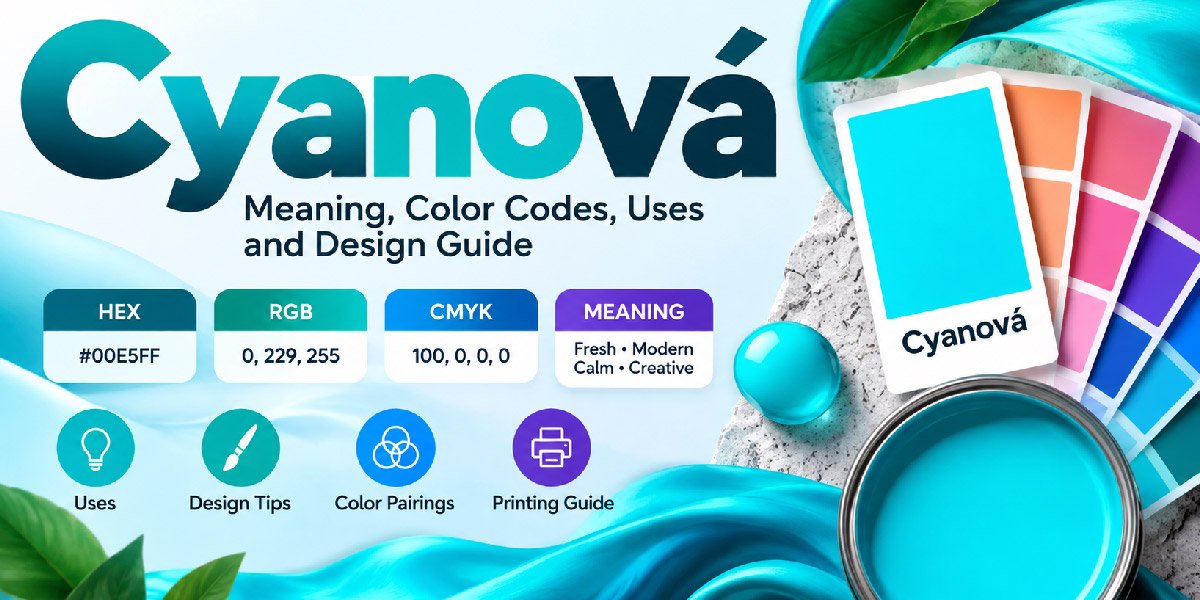
Colors influence how a design looks, feels, and communicates. Among the many shades between blue and green, cyanová stands out as an interesting term connected with cyan and bright blue-green color. It can appear fresh, vivid, clean, and highly noticeable, especially in digital environments.
The term deserves some explanation because it is sometimes presented online as though it were an entirely separate standardized color. In practice, cyan is the established technical color term, while cyanová can be encountered as a language-based form or a broader description of cyan-like shades. Understanding that distinction prevents confusion.
This guide explores cyanová from a practical perspective, including its meaning, linguistic background, color science, digital and printing applications, design possibilities, accessibility, and related colors. It also explains why exact color codes matter whenever cyanová is used professionally in branding, websites, packaging, photography, fashion, or interior design.
What Does Cyanová Mean?
Cyanová is closely associated with cyan, a vivid color located visually between green and blue. Rather than describing an entirely separate internationally standardized color, the term can be understood as referring to cyan or, depending on context, a similar blue-green shade used in visual and creative work.
The word also has a linguistic connection to Central European languages. In Czech, for example, cyanová can function as an adjective with a feminine grammatical form, as in cyanová barva. This helps explain why people searching the term may encounter both language references and modern design-related content.
Because online usage is not always technically precise, cyanová should not automatically be assigned one universal color value. If someone specifically means pure digital cyan, #00FFFF is the familiar web value. Professional projects should nevertheless specify the exact HEX, RGB, CMYK, or other required color reference.
Where Does the Name Come From?
The deeper history belongs to the word cyan rather than to a separate historical pigment named cyanová. The English color name ultimately traces back through linguistic history to Greek kyanos, a term associated with dark-blue substances or coloration. Its meaning developed considerably before modern color systems appeared.
Cyan eventually became an established part of color terminology and acquired important roles in photography, printing, optics, and digital technology. Modern screens and printing systems made the word particularly familiar because cyan is fundamental to both electronic color relationships and commercial four-color printing processes.
Cyanová should therefore be understood within this wider history rather than treated as an ancient standalone pigment. Its contemporary appearance online reflects language and modern color discussions. This distinction is useful because it separates documented cyan history from newer interpretations surrounding the cyanová keyword.
How Cyanová Works on Digital Screens
Phones, televisions, tablets, and computer monitors generally create colors using the RGB model. RGB represents red, green, and blue light. By changing the intensity of these three components, a display can reproduce a very large range of colors for digital images and interfaces.
Pure cyan appears when green and blue light are strongly combined while red is absent. In the standard 8-bit RGB notation, this gives RGB (0, 255, 255). Its corresponding familiar HEX notation is #00FFFF, producing an exceptionally bright cyan on many displays.
This does not mean every shade called cyanová must equal #00FFFF. Designers can create lighter, darker, softer, or more muted cyan variations. Screen technology, brightness, calibration, viewing conditions, and device settings can also influence how an identical numerical color value appears to different viewers.
Cyanová in Printing and CMYK
Commercial color printing usually relies on CMYK, meaning cyan, magenta, yellow, and key, with key normally referring to black. Unlike a display, which creates color using emitted light, printing produces visual results through inks applied to paper or another physical substrate.
Cyan is therefore more than a decorative color in printing. It is one of the fundamental process inks. A commonly stated basic reference for cyan is C100 M0 Y0 K0, although real output depends on the printing process, color profile, inks, substrate, and production conditions.
A vivid cyan displayed as #00FFFF should not be expected to reproduce identically on ordinary paper. Screens and printed materials have different color capabilities. When accurate reproduction matters, designers should use an appropriate color-managed workflow and review a physical proof rather than trusting an on-screen preview alone.
Useful Cyanová Color Values
When cyanová is specifically being used to mean pure digital cyan, designers can start with HEX #00FFFF and RGB (0, 255, 255). These values describe the familiar maximum-green, maximum-blue cyan used in digital color environments and standard web color definitions.
For process printing, CMYK (100, 0, 0, 0) is often provided as a simple cyan reference. However, CMYK numbers should not be considered a guaranteed visual match across every printer. Different profiles, presses, papers, inks, and conversion methods can produce noticeably different physical results.
This is why professionals should define colors according to their final medium. A website may require HEX and RGB references, while packaging may need an approved CMYK build or another printing specification. A color name such as cyanová provides direction, but numerical specifications provide production accuracy.
Cyanová, Cyan, Aqua, and Turquoise
Cyanová is most directly related to cyan, the established technical term. When someone uses cyanová to describe pure cyan, the familiar digital reference is #00FFFF. However, informal online usage may include neighboring blue-green shades, making context important when interpreting the name.
Aqua creates an interesting comparison. In standard CSS named colors, aqua and cyan both correspond to #00FFFF. Everyday language is less exact, however, and aqua may describe various watery blue-green colors rather than only that single mathematically defined digital value.
Turquoise covers another blue-green region and often appears less electrically bright than pure screen cyan. Its exact interpretation varies across color systems, products, and manufacturers. Instead of relying solely on names, designers should communicate an exact specification whenever matching a particular shade is commercially important.
Cyanová vs Teal and Aquamarine
Teal belongs to the blue-green family but normally looks considerably darker and more restrained than vivid cyan. It can create a sophisticated or subdued appearance, while maximum-intensity screen cyan can appear luminous, energetic, and strongly associated with electronic or futuristic visual environments.
Aquamarine is another neighboring color name. It is commonly associated with lighter green-blue shades and may produce a softer visual effect. Like turquoise, its everyday interpretation can vary, meaning two products carrying the aquamarine name are not necessarily guaranteed to have identical colors.
These comparisons reveal an important principle: everyday color vocabulary has flexible boundaries. Cyanová, teal, turquoise, and aquamarine may occupy related visual territory without being interchangeable. For branding or manufacturing, a defined code, approved physical sample, or standardized specification is considerably safer than descriptive terminology alone.
Why Cyanová Is Useful in Web Design
Cyan-like shades can be highly visible on digital screens, making them useful for interface elements that need attention. Designers may apply cyanová to buttons, links, icons, progress indicators, data visualizations, active navigation states, borders, illustrations, or carefully selected highlights within a larger interface.
Bright cyan becomes particularly striking against charcoal, navy, or black. This explains its frequent appearance in technology-inspired interfaces, gaming graphics, futuristic artwork, and dashboards. Against white or pale backgrounds, designers may need darker cyan variations to create sufficient definition and improve visual comfort.
A successful interface should never choose cyanová solely because it looks modern. The shade must support hierarchy, usability, and consistency. When one color represents interactive elements, designers should apply that meaning systematically so users can quickly understand what is clickable, selected, active, or important.
Accessibility and Readability
Bright colors do not automatically produce readable interfaces. Pure cyan can create weak contrast with white and certain other light colors, particularly when used behind small text. Designers should therefore test actual foreground-background combinations instead of assuming that a visually intense color automatically provides adequate readability.
Web accessibility also involves more than contrast. Important information should not depend on color alone. If cyanová indicates a selected option, notification, chart category, or status, another cue such as text, an icon, underline, pattern, shape, or label can reinforce the meaning.
The Web Content Accessibility Guidelines provide contrast requirements and broader guidance for accessible interfaces. Testing should cover text, controls, links, charts, focus states, and mobile layouts. Cyanová can remain an effective design element while being adjusted in brightness or surrounding contrast to support usability.
Using Cyanová in Branding
A strong brand palette must remain recognizable across many environments. Cyanová can provide a distinctive blue-green direction for businesses seeking a clean, energetic, digital, or contemporary appearance. It may work as the primary brand color or as a smaller accent within a broader palette.
Technology businesses are natural candidates, but cyan shades are not restricted to technology. They can appear in education, travel, sports, wellness, entertainment, retail, creative services, and other industries. What the color communicates ultimately depends on typography, imagery, supporting colors, messaging, and overall brand strategy.
Consistency becomes especially important when a brand operates across digital and physical media. A proper style guide can define approved RGB and HEX references alongside print specifications. Without these rules, websites, advertisements, packaging, signage, and social graphics may gradually display noticeably different versions of cyanová.
Cyanová in Art and Photography
Artists can use cyan-like colors for oceans, atmospheric effects, abstract compositions, lighting, shadows, science-fiction environments, and high-energy contrasts. Pairing cyan with neighboring blues can create cool harmony, while combining it with warmer hues can produce much stronger visual separation and dramatic compositions.
Cyan also has a notable photographic connection through cyanotype, a historical photographic process famous for producing characteristic blue images. Cyanotype is a specific chemical photographic technique, however, and should not be confused with simply applying a blue or cyan filter to a modern digital photograph.
Digital photographers can introduce cyan through color grading, selective adjustments, split-toning techniques, backgrounds, or controlled lighting. The effect can range from subtle coolness to a strongly stylized atmosphere. Color-managed editing becomes especially useful when finished photographs will move from calibrated displays into professional printing workflows.
Cyanová in Fashion and Interiors
In fashion, cyanová can function as either a statement color or a small accent. Bright versions may suit sportswear, accessories, summer clothing, footwear, or contemporary fashion, while darker blue-green variations can create a more restrained appearance suitable for garments intended to feel less visually intense.
Interior spaces offer equally varied possibilities. Cyan-inspired colors can appear in painted walls, upholstery, cushions, rugs, artwork, ceramics, curtains, or decorative details. Natural wood and warm neutrals can soften the cool character, while dark materials can create a more dramatic contemporary combination.
Lighting must be considered before making permanent interior choices. Paint and fabric can appear different in daylight, warm lamps, and cool artificial illumination. Small physical samples should therefore be viewed inside the intended room at different times before an entire wall, furniture piece, or textile installation is approved.
Colors That Work Well With Cyanová
Black, charcoal, and deep navy can provide strong visual contrast against bright cyanová. These combinations are especially useful when creating technology-oriented interfaces, gaming visuals, posters, packaging, or digital graphics where the blue-green element needs to appear luminous and immediately noticeable.
White, gray, beige, and other neutrals can create a cleaner and more restrained palette. Natural wood tones introduce additional warmth in interiors. Designers can also combine cyan with neighboring blues and greens when they want a smoother, more harmonious transition rather than dramatic contrast.
Warm accents such as coral or orange can create energetic complementary tension with blue-green colors. The proportions require careful control because multiple highly saturated colors can compete for attention. A practical approach is to establish one dominant palette and reserve stronger contrasting colors for deliberate focal points.
Color Psychology and Cyanová
Cyan and neighboring blue-green shades are frequently associated in design discussions with freshness, water, clarity, cleanliness, technology, and calmness. Such associations can explain why similar colors appear in digital products, aquatic themes, contemporary graphics, and visual identities designed to feel clean or forward-looking.
These associations should not be treated as universal psychological laws. Color responses depend on culture, personal experience, context, brightness, saturation, surrounding colors, and even the object carrying the color. The same bright cyan can appear peaceful in one composition and intensely energetic in another.
Designers should therefore use color psychology as contextual guidance rather than a guarantee of human behavior. Testing a palette with its intended audience is more reliable than assuming cyanová will automatically generate trust, concentration, relaxation, or any other specific emotional or behavioral response.
How to Choose the Right Cyanová Shade
Begin with the intended application. A glowing cyan suitable for a gaming interface may be inappropriate for printed stationery or a relaxing bedroom. Decide whether the color needs to feel energetic, restrained, dark, soft, technical, natural, or decorative before selecting its exact numerical value.
Next, test the shade in context rather than viewing an isolated swatch. Typography, surrounding colors, screen backgrounds, paper, fabrics, lighting, and surface finishes all affect perception. Comparing several variations within the actual design usually produces a more reliable decision than selecting from a generic color chart.
Finally, document the approved specification. Digital projects should record appropriate HEX and RGB values, while printed work should follow the printer’s color-management requirements. Brand systems may require multiple approved equivalents because one numerical formula cannot always guarantee an identical appearance across fundamentally different reproduction technologies.
Final Thoughts
Cyanová is best understood through its close relationship with cyan and the broader blue-green color family. While the term appears in language and online design discussions, cyan remains the established technical color name, and cyanová should not automatically be presented as a separate internationally standardized shade.
When cyanová specifically means pure digital cyan, #00FFFF and RGB (0, 255, 255) provide familiar references. Printing requires different considerations because cyan is a fundamental CMYK process color and physical output depends on ink, substrate, profiles, equipment, lighting, and production conditions.
Its real strength lies in versatility. Cyanová-inspired shades can support websites, branding, art, photography, packaging, fashion, interfaces, and interiors. The best results come from defining the exact shade, checking accessibility, testing the final medium, and using the color deliberately rather than depending on its name alone.
(FAQs)
What is cyanová?
Cyanová is a term closely associated with cyan and blue-green colors. It also has a linguistic connection with Czech and related language usage. In technical English color terminology, cyan is the more established term rather than cyanová being a separate standardized international color.
What is the HEX code for cyanová?
If cyanová specifically refers to pure digital cyan, the familiar HEX value is #00FFFF. However, cyanová itself should not automatically be assumed to have one universal HEX value because the term can also be used more broadly for cyan-like blue-green shades.
What RGB value is used for pure cyan?
Pure cyan uses RGB (0, 255, 255) in the standard 8-bit RGB model. Red is set to zero while green and blue are at their maximum values. The combination of green and blue light produces bright cyan on a digital display.
Is cyanová the same as turquoise?
Not necessarily. Cyanová is closely associated with cyan, whereas turquoise commonly describes a broader range of blue-green colors that may appear greener, softer, or less intense. Exact color specifications are more reliable than names when a particular shade needs to be reproduced accurately.
Why does cyanová look different when printed?
Screens generate colors with RGB light, whereas most commercial full-color printing uses CMYK inks. Paper, ink, printer technology, profiles, surface finish, calibration, and lighting can all influence the finished appearance, so vivid screen cyan may not reproduce identically in physical printing.
What colors go well with cyanová?
Cyanová can work effectively with black, charcoal, navy, white, gray, beige, and other neutral shades. Orange or coral can provide stronger warm contrast. The best combination depends on the exact cyan shade, visual hierarchy, medium, accessibility requirements, and intended design style.
you may also read: Uncuymaza: Meaning, Origin, Uses and Facts Explained









Discussion about this post