

Peptide Stacks Explained: Why Some Vials Hold Two or Three Peptides
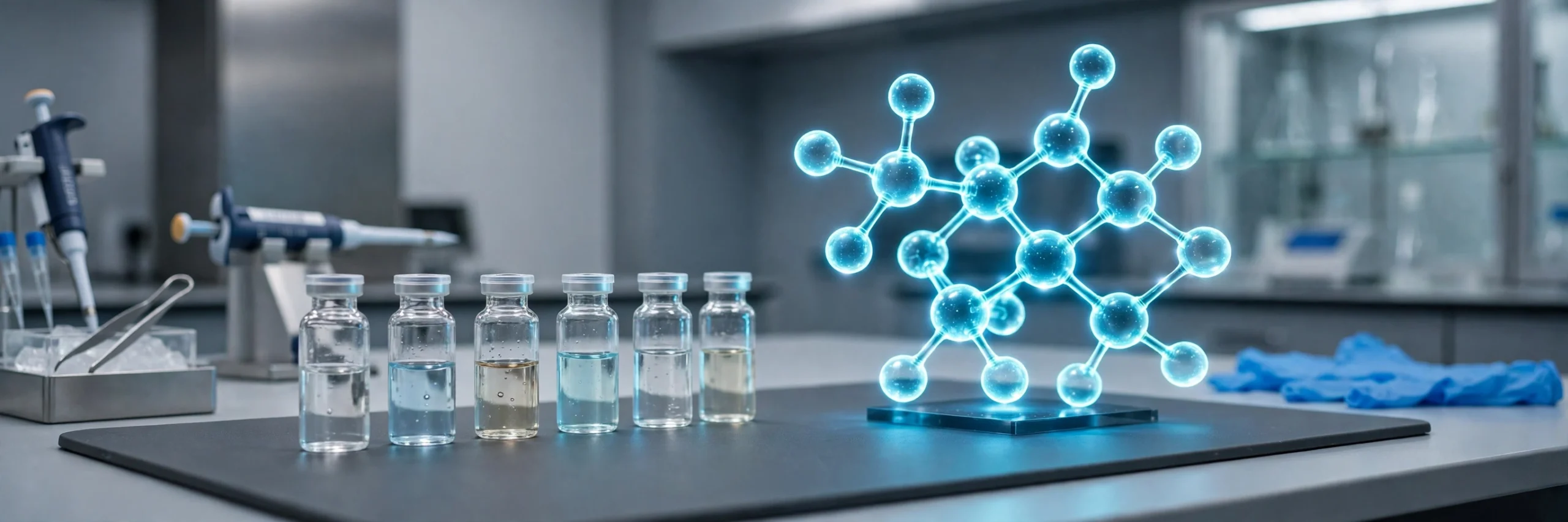
A peptide stack, also called a peptide blend, is two or more peptides dissolved together and freeze-dried into a single powder in one vial. The common blends start with BPC-157 and TB-500 and add GHK-Cu, then KPV. Because the ratio is locked in when the vial is filled, a blend is simpler to store and label than separate vials, and impossible to adjust.
What is a peptide stack?
In everyday use, "stack" and "blend" mean the same thing. More than one peptide, one vial.
The technical word is co-lyophilized. Lyophilization is freeze-drying, which the FDA's inspection guide describes in three stages: freezing, primary drying as the ice turns straight to vapor under vacuum, and secondary drying to drive off the last bound water. When several peptides share the solution before freezing, the dry cake has all of them mixed through it, and no single component can be picked back out.
What are the main peptide blends?
Three blends show the idea, and each builds on the last.
| Blend | What's in one vial | Total peptide |
|---|---|---|
| Wolverine 5/5 | BPC-157 5 mg, TB-500 5 mg | 10 mg |
| Wolverine 10/10 | BPC-157 10 mg, TB-500 10 mg | 20 mg |
| GLOW | GHK-Cu 50 mg, BPC-157 10 mg, TB-500 10 mg | 70 mg |
| KLOW | GHK-Cu 50 mg, BPC-157 10 mg, TB-500 10 mg, KPV 10 mg | 80 mg |
Wolverine is the base pair. BPC-157 is a synthetic chain of 15 amino acids whose sequence comes from a stomach protein, and TB-500 is a lab-made peptide tied to thymosin beta-4, a protein found in nearly every cell. GLOW adds 50 mg of GHK-Cu, a three-amino-acid peptide holding a copper ion. KLOW adds 10 mg of KPV, the three-amino-acid tail of the hormone alpha-MSH, and a side-by-side of KLOW vs GLOW shows that those 10 mg are the entire difference between the two.
How are peptide blends labeled?
Two ways, and you'll see both. Some labels list each component, so "10/10 mg" means 10 mg of BPC-157 plus 10 mg of TB-500, or 20 mg in all. Others give only the total, with the split stated as a ratio by weight. One catalog sells Wolverine as 5/5 mg and 10/10 mg but lists GLOW simply as 70 mg, five parts GHK-Cu to one part each of the other two, and KLOW as 80 mg at 5:1:1:1.
Weight isn't headcount, either.
GHK-Cu is a small molecule at about 404 g/mol, while BPC-157 weighs about 1,420 g/mol. So GLOW's 50 mg of GHK-Cu comes to roughly 124 micromoles against about 7 for its 10 mg of BPC-157, which means that by molecule count the blend is about 18 parts GHK-Cu to one part BPC-157, a ratio no 50/10/10 label shows.
Once the powder is dissolved, each component's concentration is its own milligrams divided by the volume added. Two milliliters in a GLOW vial gives 25 mg/mL of GHK-Cu and 5 mg/mL each of BPC-157 and TB-500.
What's the trade-off of a fixed ratio?
Convenience on one side. A blend means one vial, one label, one lot number and one set of storage conditions, and every vial of the same size carries the same split.
Flexibility on the other. Nobody can dial one component up or down, and after mixing the peptides can't be separated, so changing the proportions means starting from single vials. Price is a separate question, and a breakdown of how the Wolverine blend compares with BPC-157 alone puts per-milligram costs side by side. No published study has tested the Wolverine pair or the GLOW combination as a blend, so what is known about each one comes from studies of its parts.
FAQs
What is a peptide stack?
Two or more peptides freeze-dried together in one vial at a fixed ratio. "Stack" and "blend" are used interchangeably.
What is the difference between GLOW and KLOW?
KLOW is GLOW plus 10 mg of KPV. GLOW holds 70 mg in total and KLOW holds 80 mg.
Can the peptides in a blend be separated?
No. They share one powder, and once dissolved they share one solution.
Sources
- U.S. Food and Drug Administration. Lyophilization of Parenteral (7/93), Inspection Guide.
- Maquart FX, et al. Stimulation of collagen synthesis in fibroblast cultures by the tripeptide-copper complex glycyl-L-histidyl-L-lysine-Cu2+. FEBS Letters, 1988.
- Sosne G, et al. Biological activities of thymosin beta4 defined by active sites in short peptide sequences. FASEB Journal, 2010.
- Brzoska T, et al. Alpha-melanocyte-stimulating hormone and related tripeptides: biochemistry, antiinflammatory and protective effects in vitro and in vivo. Endocrine Reviews, 2008.







Discussion about this post