

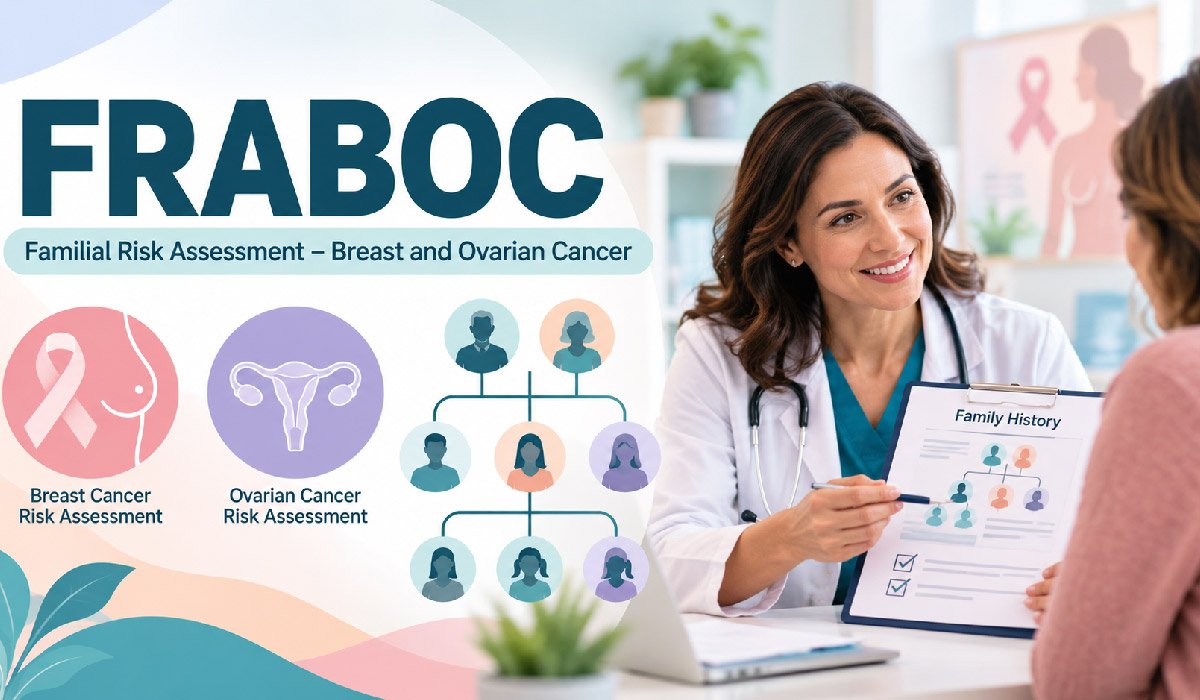
Fraboc, more accurately written as FRA-BOC, stands for Familial Risk Assessment – Breast and Ovarian Cancer. It was an Australian clinical tool that helped health professionals understand a woman’s possible breast and ovarian cancer risk by looking at patterns in her family history.
FRABOC was not a cancer test, genetic test, scan, or diagnosis. It did not tell someone whether they had cancer. Instead, it helped doctors and nurses organize family-history information and place patients into broad risk groups that could guide further assessment.
The original FRABOC tool is no longer available through Cancer Australia. However, the name still appears in older medical records, referral letters, clinical documents, and online health resources. Today, newer tools such as iPrevent, CanRisk, and IBIS can provide more detailed risk assessments.
What Is FRABOC?
FRABOC was an online familial cancer risk-assessment tool used in Australia. Its full name was Familial Risk Assessment – Breast and Ovarian Cancer.
It was mainly designed for health professionals, including general practitioners and nurses. The tool helped them review a patient’s family history and decide whether that history suggested an average, moderately increased, or potentially high risk of developing breast or ovarian cancer.
The tool focused on family patterns rather than current symptoms. A FRABOC assessment could therefore help guide discussions about screening, specialist referral, genetic counselling, or further investigation, but it could not diagnose cancer.
What Does FRABOC Stand For?
FRABOC can be divided into two parts:
FRA means Familial Risk Assessment.
BOC means Breast and Ovarian Cancer.
The word “familial” is important because FRABOC focused on cancer patterns within families.
It looked at whether breast or ovarian cancer appeared in close relatives, how many relatives were affected, how old they were when diagnosed, and whether unusual cancer patterns appeared in the family.
FRABOC did not directly examine a person’s genes. It used family history as an indicator of possible risk.
Why Was FRABOC Developed?
Family cancer history can be difficult to interpret.
Having one relative with breast cancer does not automatically mean someone has a high inherited cancer risk. Breast cancer is relatively common, so many families will have at least one affected person.
Doctors therefore need more detail.
They may need to know whether several relatives had cancer, whether they were closely related, whether the cancers occurred at young ages, and whether breast and ovarian cancers appeared on the same side of the family.
FRABOC provided a structured way to evaluate these details.
Instead of relying on one simple question about family cancer history, the tool helped health professionals look at the overall pattern.
Who Was FRABOC Designed For?
FRABOC was mainly created for healthcare professionals rather than for people to use alone at home.
A GP, nurse, or other health professional could collect family-history information and use the tool to understand whether the pattern suggested increased familial risk.
This distinction matters because risk calculators require context.
A person may have incomplete information about relatives, uncertain cancer diagnoses, or other risk factors that affect how the result should be interpreted.
FRABOC was therefore best understood as a clinical decision-support tool rather than a self-diagnosis service.
How Did FRABOC Work?
FRABOC mainly worked by examining a person’s family cancer history.
A health professional would gather information about relatives on both the mother’s and father’s sides of the family.
Important details included the relationship of each relative, the cancer they developed, and their approximate age at diagnosis.
The family pattern was then used to place the person into a broad risk category.
These categories helped indicate whether routine management was suitable or whether a more detailed assessment might be needed.
FRABOC did not predict exactly what would happen to one individual. It estimated risk based on family patterns.
What Family History Information Did FRABOC Consider?
Family relationships were an important part of FRABOC.
First-degree relatives include parents, brothers, sisters, and children.
Second-degree relatives can include grandparents, aunts, uncles, nieces, nephews, and grandchildren.
The tool also considered the type of cancer and the age at diagnosis.
Family patterns that could attract more attention included several relatives with breast or ovarian cancer, cancer diagnosed at an unusually young age, breast cancer affecting both breasts, male breast cancer, or breast and ovarian cancer occurring within the same family.
Both sides of the family mattered.
An inherited cancer-related gene change can come from a father as well as a mother, so paternal family history should not be ignored.
What Were the FRABOC Risk Categories?
FRABOC used broad risk groups to organize familial breast cancer risk.
The historical categories included:
- At or slightly above average risk
- Moderately increased risk
- Potentially high risk
These categories were designed to guide clinical decisions rather than provide a guaranteed prediction.
They are also historical categories.
Someone should not use old FRABOC information today to calculate their own current breast or ovarian cancer risk.
Modern risk tools use updated models and can consider a wider range of information.
What Did an Average FRABOC Risk Result Mean?
The lowest historical FRABOC category was described as at or slightly above average risk.
Under older guidance, most women were expected to fall into this group.
Examples could include women with no confirmed family history of breast cancer or limited family history without stronger high-risk patterns.
Being placed in this group did not mean cancer was impossible.
People without a strong family history can still develop breast cancer.
The category only suggested that the family pattern did not show the stronger signs linked with moderately increased or potentially high familial risk.
What Did a Moderately Increased FRABOC Risk Result Mean?
The second FRABOC category represented moderately increased risk.
A family history could fall into this group when breast cancer appeared in a close relative at a younger age or when more than one relevant family member was affected.
The complete pattern mattered.
Doctors needed to consider how closely the relatives were related, which side of the family they came from, and whether stronger hereditary-risk features were present.
A moderately increased result still did not mean someone would definitely develop cancer.
It only indicated that their estimated familial risk was above average.
What Did a Potentially High FRABOC Risk Result Mean?
Potentially high risk was the highest broad FRABOC category.
Certain family patterns could suggest that further specialist assessment was appropriate.
These could include several affected relatives on the same side of the family, breast cancer diagnosed at a very young age, male breast cancer, cancer affecting both breasts, or breast and ovarian cancer occurring in the same person or family.
A known cancer-related gene change in a family could also be important.
However, being classified as potentially high risk was not the same as receiving a cancer diagnosis.
It could simply mean that further assessment was worth considering.
How Did FRABOC Assess Breast Cancer Risk?
FRABOC looked at the overall pattern of breast cancer within a family.
The number of affected relatives was important, but it was not the only factor.
The closeness of those relatives also mattered.
For example, breast cancer in a parent or sibling could carry different significance from cancer in a more distant relative.
Age at diagnosis could also be important because cancer appearing unusually early may sometimes suggest a stronger inherited component.
Patterns involving male breast cancer or cancer in both breasts could also influence the assessment.
How Did FRABOC Assess Ovarian Cancer Risk?
Ovarian cancer was another important part of the FRABOC assessment.
Doctors could consider how many relatives had ovarian cancer and whether ovarian cancer appeared alongside breast cancer in the same family.
Certain combinations of breast and ovarian cancer may raise more concern about inherited cancer susceptibility than one isolated cancer case.
However, family history alone could not confirm a hereditary cancer syndrome.
Further clinical or genetic assessment could be needed before any conclusion was made.
Was FRABOC a Cancer Test?
No.
FRABOC was not a diagnostic test.
It was not a mammogram, ultrasound, biopsy, blood test, or physical examination.
It could not tell whether a person currently had breast or ovarian cancer.
Its job was to estimate familial risk based mainly on patterns in the family.
Risk and diagnosis are very different.
A risk estimate describes probability.
A diagnosis determines whether a disease is actually present.
This distinction is especially important when FRABOC appears in an old medical document.
Was FRABOC a Genetic Test?
FRABOC was not a genetic test.
Genetic testing examines DNA to look for particular inherited changes.
FRABOC did not do that.
Instead, it looked at family-history patterns that might suggest whether a person needed a more detailed assessment.
If the family history raised concern, a healthcare professional could consider referral for genetic counselling or testing.
The FRABOC result itself could not confirm whether someone carried a BRCA1, BRCA2, or other cancer-related genetic variant.
How Was FRABOC Related to BRCA1 and BRCA2?
BRCA1 and BRCA2 are genes that can be linked with inherited breast and ovarian cancer risk when certain harmful variants are present.
FRABOC and BRCA testing served different purposes.
FRABOC assessed family history.
BRCA testing examines genetic material.
A family with several cases of early breast cancer, ovarian cancer, or male breast cancer might show a pattern that deserves further investigation.
However, that family pattern alone does not prove that a BRCA variant is present.
Genetic testing is a separate medical process.
What Happened After a Higher FRABOC Risk Assessment?
A higher-risk FRABOC result did not automatically mean that treatment was needed.
Instead, it could help a health professional decide whether further assessment should be considered.
Possible next steps could include reviewing the family history in greater detail, referring the patient to a family cancer service, discussing genetic counselling, or considering appropriate screening and risk-management options.
The next step depended on the individual situation.
FRABOC was therefore part of a decision-making process rather than a final answer.
Is FRABOC Still Available?
No.
The original FRABOC tool is no longer available through Cancer Australia.
This is why people searching for a FRABOC calculator today may struggle to find the original service.
Older websites, medical forms, referral documents, and archived resources may still mention it because the tool was used for many years.
Those references are historical.
Someone looking for a current cancer-risk assessment should use modern clinical guidance rather than an old FRABOC calculator or historical risk table.
Why Does FRABOC Still Appear in Medical Records and Online?
Medical terminology can remain in documents long after a particular tool has been retired.
FRABOC may still appear in old GP letters, referral forms, hospital documents, PDFs, archived cancer information, and older clinical templates.
This can confuse patients who find the term years later.
Seeing FRABOC in a medical record does not mean the person had cancer.
It usually means that family cancer risk was being discussed or assessed using the framework available at that time.
What Replaced FRABOC?
In Australia, newer risk-assessment approaches are now used.
One of the most important is iPrevent.
iPrevent is designed to provide a more personalized breast cancer risk assessment.
It can consider family history together with other personal and medical factors.
Other modern models and tools include CanRisk and IBIS, also known as the Tyrer-Cuzick model.
These newer systems do not simply copy FRABOC.
They use more detailed methods and can consider a wider range of risk factors.
What Is iPrevent?
iPrevent is a modern breast cancer risk-assessment and management tool.
It can collect information about family history as well as personal medical, reproductive, lifestyle, and breast-health factors.
The result can provide a more individualized estimate than the broad historical categories used by FRABOC.
Family-history questions may include breast, ovarian, pancreatic, and prostate cancer.
iPrevent is intended to support informed discussions about breast cancer risk and possible management options.
It should still be used appropriately and interpreted in the context of current medical guidance.
FRABOC vs iPrevent
FRABOC and iPrevent share the general goal of helping people understand cancer risk, but they are different tools.
FRABOC was mainly focused on familial patterns involving breast and ovarian cancer.
It used broad risk categories.
iPrevent uses a broader set of information and can create a more personalized breast cancer risk estimate.
FRABOC is historical and no longer available through Cancer Australia.
iPrevent is a newer approach designed around modern risk-assessment methods.
This difference shows how cancer-risk assessment has developed over time.
How Does CanRisk Differ From FRABOC?
CanRisk is another modern cancer-risk assessment tool.
It is based on BOADICEA models and can use detailed family history, genetic information, and other risk factors.
This is more complex than the old FRABOC approach.
FRABOC mainly organized people into broad familial-risk categories.
CanRisk can generate more detailed estimates based on individual information.
However, CanRisk should not be confused with FRABOC’s direct historical identity.
They come from different generations of cancer-risk assessment.
How Does the IBIS or Tyrer-Cuzick Model Differ From FRABOC?
The IBIS model, also known as Tyrer-Cuzick, is another breast cancer risk model.
It can consider family history together with additional personal and reproductive information.
FRABOC was more focused on family-history patterns and broad categories.
IBIS can produce a more individualized breast cancer risk estimate.
This reflects a wider change in medicine from simple family-history classifications toward multifactorial risk models.
Why Accurate Family Cancer History Still Matters
FRABOC may be retired, but family history remains important.
A useful family cancer history can include:
- which relative had cancer
- how that person is related
- the type of cancer
- approximate age at diagnosis
- whether cancer affected both breasts
- whether one person had multiple cancers
- whether male breast cancer occurred
- whether genetic testing was performed
- whether a known inherited variant was found
Both the mother’s and father’s sides of the family should be considered.
More complete information can help healthcare professionals understand the pattern more accurately.
Can You Use an Old FRABOC Result Today?
An old FRABOC result may still be useful as part of a person’s medical history, but it should not automatically be treated as a current risk estimate.
Cancer-risk assessment changes over time.
A person’s age changes.
New family cancer diagnoses may appear.
Relatives may receive genetic testing.
Risk models may also improve.
For these reasons, someone concerned about their current cancer risk should discuss their updated personal and family history with an appropriate healthcare professional rather than relying on an old FRABOC category.
Common Misunderstandings About FRABOC
One common mistake is thinking FRABOC was a cancer test.
It was not.
Another mistake is assuming that a high familial-risk category meant someone would definitely develop cancer.
It did not.
A third misunderstanding is believing that any family history of breast cancer automatically means inherited cancer.
That is also incorrect.
Many factors can influence cancer risk.
FRABOC helped organize family information, but it could not provide a diagnosis, confirm a genetic condition, or predict the future with certainty.
Key Facts About FRABOC
FRABOC stands for Familial Risk Assessment – Breast and Ovarian Cancer.
It was an Australian clinical risk-assessment tool.
It was mainly used by healthcare professionals.
Its main focus was family cancer history.
It placed people into broad risk groups.
FRABOC was not a genetic test.
It was not a cancer diagnosis.
The original tool is no longer available through Cancer Australia.
Modern breast cancer risk assessment can involve tools such as iPrevent, CanRisk, and IBIS.
Final Thoughts
FRABOC was an important historical Australian tool for assessing familial breast and ovarian cancer risk. It helped health professionals organize family-history information and identify people who might need more detailed assessment.
The tool was never a cancer diagnosis or genetic test. It simply estimated risk using patterns seen among relatives.
Today, FRABOC is no longer available through Cancer Australia, and newer tools can provide more detailed and personalized risk estimates.
Its main lesson still matters: family cancer history can provide useful information, but it must be interpreted carefully. Anyone concerned about breast or ovarian cancer risk should use current medical guidance and discuss their individual history with a qualified healthcare professional rather than relying on historical FRABOC categories.
(FAQs)
What does FRABOC stand for?
FRABOC stands for Familial Risk Assessment – Breast and Ovarian Cancer. It was an Australian clinical tool designed to help health professionals assess breast and ovarian cancer risk based mainly on family-history patterns.
What was FRABOC used for?
FRABOC was used to organize family cancer information and classify familial breast and ovarian cancer risk. It could help healthcare professionals decide whether routine care, further assessment, genetic counselling, or specialist referral might be appropriate.
Is FRABOC still available?
No. The original FRABOC tool is no longer available through Cancer Australia. It may still appear in old medical records, referral letters, archived webpages, and historical cancer information.
Was FRABOC a genetic test?
No. FRABOC did not examine DNA. It assessed family-history patterns. Genetic testing for genes such as BRCA1 and BRCA2 is a separate process that may be considered when a family history suggests possible inherited risk.
Could FRABOC diagnose breast or ovarian cancer?
No. FRABOC could not diagnose cancer. It was a risk-assessment tool rather than a mammogram, biopsy, blood test, scan, or diagnostic examination.
What replaced FRABOC?
Modern Australian breast cancer risk assessment now uses newer approaches, including iPrevent. Other current risk models include CanRisk and IBIS. These tools can consider more detailed information than the old FRABOC categories.
What is the difference between FRABOC and iPrevent?
FRABOC mainly used family-history patterns and broad risk groups. iPrevent can consider family history together with additional personal, medical, reproductive, and lifestyle factors to produce a more individualized breast cancer risk assessment.
Why does FRABOC still appear in old medical records?
FRABOC was used in Australian healthcare for years, so references remain in older clinical documents, referral forms, PDFs, and medical records. Its presence usually reflects historical cancer-risk assessment rather than a current diagnosis or active test.
you may also read: Cnlawblog: A Complete Guide to Its Content, Legal Topics, Purpose, and Reliability









Discussion about this post