

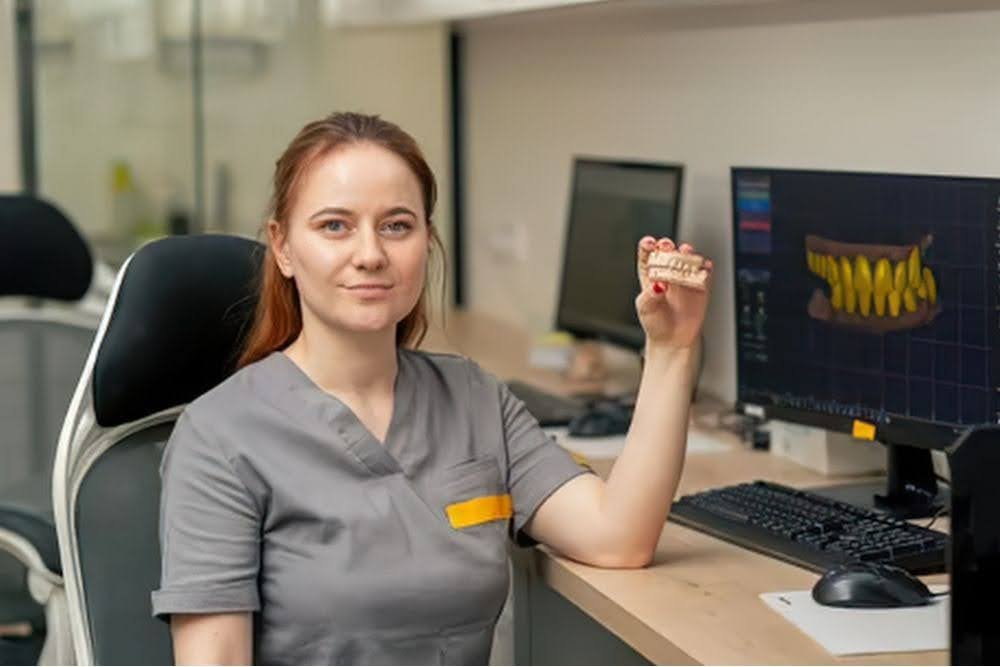
Imagine someone who has struggled with failing teeth or loose dentures for years. They walk into a dental clinic with a mouth full of problems and, months later, walk out with a full set of fixed teeth that look natural and stay put. The dentist and surgeon get a lot of the credit. But behind the scenes, there is another team doing a huge share of the work: the dental lab.
All-on-X treatment depends on the lab at almost every stage. In this guide, you will learn what All-on-X means, what a dental lab actually does for these cases, which materials are used, and why the partnership between clinic and lab matters so much for the final result.
What Is All-on-X?
All-on-X is a way to replace a full arch of teeth, meaning all the upper teeth, all the lower teeth, or both. Instead of placing one implant for every missing tooth, the surgeon places a small number of implants, usually four to six, into the jawbone. A full row of teeth is then fixed onto those implants.
The “X” simply stands for the number of implants used. A patient with strong bone might need four. Someone with softer bone, or a bigger bite force, might need six or more.
Unlike regular dentures, an All-on-X bridge is not taken out at night. It is screwed onto the implants, and only the dental team can remove it. For many patients, that means eating, talking, and laughing without worrying about teeth slipping.
What Does a Dental Lab Do?
A dental lab is a workshop where trained technicians make crowns, bridges, dentures, and other dental devices. The dentist examines the patient and takes records. The lab turns those records into the teeth the patient will actually wear.
For a single crown, the lab’s job is fairly simple. For a full arch, it becomes far bigger. The technicians have to design a whole row of teeth that fits perfectly on several implants at once, matches the patient’s face, and can handle years of chewing.
Think of the dentist as the architect and the lab as the builder. The architect plans the house, but the builder decides how every beam fits together. If the builder gets one measurement wrong, the whole structure can suffer.
The Lab’s Role Before Surgery
Good All-on-X results start long before the first implant is placed. The lab often helps with planning from day one.
The dentist sends the lab scans of the patient’s mouth, photos of their face and smile, and a 3D X-ray called a CBCT scan. Using design software, technicians create a digital mock-up of the new teeth. This shows how long the teeth should be, where the smile line sits, and how the lips will be supported.
From that design, the lab can also make a surgical guide. This is a custom plastic template that fits over the jaw during surgery. It shows the surgeon exactly where and at what angle to place each implant. Planning the teeth first and the implants second is sometimes called “prosthetically driven” planning. It simply means the final smile decides where the implants go, instead of the other way around.
The Temporary Teeth
Most All-on-X patients leave surgery on the same day, or within a few days, with a set of temporary teeth. These are often called provisionals.
The lab usually makes provisionals from a strong acrylic called PMMA. They are lighter and less durable than the final teeth, but that is on purpose. During the first few months, the bone is bonding with the implants, and the gums are healing and changing shape. The temporary teeth protect the implants while giving the patient a working smile.
Provisionals also act like a test drive. The patient can try out the look, feel, and bite of their new teeth. If something is off, such as the teeth feeling too long or speech sounding odd, changes can be made before the final set is built.
Healing usually takes around three to six months, though treatment outcomes vary depending on individual circumstances.
Building the Final Teeth
Once healing is complete, the dentist takes new, highly accurate records of the implant positions. This is one of the most important steps in the whole process.
The final bridge must have what technicians call a “passive fit.” That means it sits on every implant at once without pushing, pulling, or twisting any of them. Even a tiny mismatch, thinner than a human hair, can put stress on the implants and screws over time. To check the fit, labs often make a verification jig, which is a rigid model used to confirm that the implant positions recorded in the mouth match the lab model.
Next, the patient usually tries on a mock-up of the final teeth. The dentist checks the colour, shape, bite, and how the teeth look with the patient’s lips and face. Only after everyone is happy does the lab make the final bridge.
Searching for nz dental lab services that handle full-arch work will show that labs vary a great deal in their equipment and experience. Dentists often ask to see past All-on-X cases and learn how the lab checks fit before choosing who to work with.
Common Materials for All-on-X Bridges
Labs use a few main materials for final All-on-X bridges. Each one has strengths and tradeoffs.
Acrylic on a titanium bar is a classic option. A strong metal bar connects the implants, and acrylic teeth and gums are attached on top. It is lighter, softer to bite on, and easier to repair if a tooth chips. However, acrylic can wear down and stain over the years.
Zirconia is a very hard, tooth-coloured ceramic. A full zirconia bridge is milled from a single solid block by a computer-controlled machine. It resists stains and wear very well and can look extremely natural. On the downside, it is harder to repair if it breaks and usually costs more.
Hybrid options combine a titanium bar with zirconia or composite teeth. These aim to balance strength, looks, and repairability.
The right material depends on the patient’s bite force, budget, opposing teeth, and how they grind or clench. The dentist and lab usually choose together.
Why Digital Technology Matters
Modern labs rely heavily on digital tools. Intraoral scanners capture the mouth in 3D without messy moulds. Design software lets technicians build a full arch on screen and adjust it down to fractions of a millimetre. Milling machines and 3D printers then turn those designs into real parts.
Digital workflows have a few big advantages. They are very precise, which helps with passive fit. They also save the design, so if a patient ever breaks a bridge, the lab can often make a new one from the saved file instead of starting over.
Here is an example. Picture a patient in their sixties who has worn upper dentures for over a decade. Their temporary All-on-X teeth fit well, but they mention that the front teeth feel a little long when they smile. The lab adjusts the saved digital design, shortens the front teeth slightly, and mills the final zirconia bridge. The patient gets a final smile that matches what they asked for, with no guesswork.
How Dentists Choose the Right Lab
Full-arch work is one of the most demanding jobs a lab can take on, so dentists tend to choose carefully. They look at experience, communication, and quality control.
Many clinics prefer to partner with an nz dental lab they can talk to easily, because quick back-and-forth helps when fine-tuning a smile.
Other things dentists look for include clear timelines, the lab’s range of materials, how it handles remakes or repairs, and whether technicians can join planning discussions.
What Patients Should Know
Most patients never meet their lab technician, but it is fine to ask your dentist about the lab. You can ask what material your bridge will be made from, how long the process will take, and what happens if a tooth chips or breaks later.
Looking after your bridge also helps it last. Clean under and around it every day with a water flosser or special brushes, because food can collect where the bridge meets the gums. Attend regular check-ups, where the dentist may remove the bridge for a deeper clean and to check the screws and implants.
Final Thoughts on All-on-X Dental Labs
All-on-X can give people a full set of fixed teeth using just a handful of implants. While the dentist and surgeon guide the treatment, the dental lab designs the smile, makes the surgical guide, builds the temporary teeth, and makes the final bridge with a precise, passive fit.
If you are considering full-arch treatment, ask your dental team about every step, including the lab work behind it. The more you understand, the more confident you can feel about your new smile.









Discussion about this post