

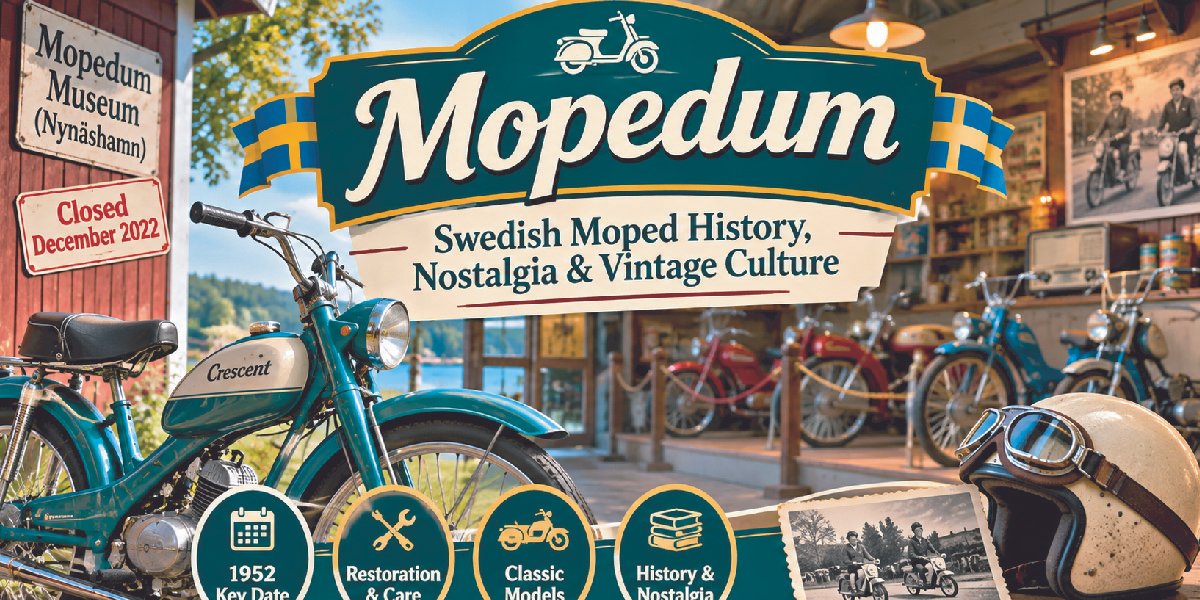
Mopedum is a name connected with vintage mopeds, Swedish transport history, and memories of everyday life from earlier decades. It became especially familiar through a nostalgia museum in Nynäshamn, where classic vehicles were displayed together with objects from the past.
The subject is interesting because old mopeds tell a bigger story than their engines alone. These small machines changed how people travelled, worked, met friends, and enjoyed their independence. Over time, they also became closely connected with youth culture and personal freedom.
Today, the original Mopedum museum is permanently closed, but its historical theme remains worth exploring. This guide explains Mopedum, its museum background, Swedish moped history, vintage collecting, restoration, maintenance, and why these simple two-wheelers still attract enthusiasts today.
What Is Mopedum?
Mopedum is best understood as a name connected with Swedish veteran mopeds and nostalgia. It became known through a museum that combined old motorized two-wheelers with objects and environments representing ordinary life during several important decades of twentieth-century Swedish history.
The attraction was different from a technical vehicle collection focused only on engines and specifications. Its wider historical setting helped visitors understand where mopeds belonged in everyday society and how transportation was connected with homes, work, leisure, shopping, and social activities.
For modern readers, Mopedum is therefore useful as both a museum-history subject and an introduction to classic moped culture. The physical attraction no longer operates, but interest in the vehicles, designs, memories, and mechanical history associated with it continues among enthusiasts.
Where Was the Mopedum Museum?
The former Mopedum museum was located at Vikingavägen 39 in Nynäshamn, Sweden. Archived tourism information presented it as a nostalgia attraction where people could discover veteran mopeds together with familiar objects associated with the 1950s, 1960s, and 1970s.
Its location offered visitors an opportunity to experience transportation history without needing specialist mechanical knowledge. Someone interested in vintage interiors, family memories, old consumer products, or Swedish culture could enjoy the displays even without knowing much about engines or motorcycle manufacturing.
Older travel pages and online references may still mention the Nynäshamn address. Readers should remember that these are historical references rather than current visitor information. The address should not be interpreted as evidence that the original Mopedum attraction is operating today.
What Made Mopedum Different?
Mopedum was interesting because it placed transportation inside everyday history. Instead of treating each moped simply as a mechanical object, the museum connected vehicles with the environments, products, and habits that surrounded the people who originally owned and used them.
That approach could make an ordinary machine more meaningful. Furniture, clothing, household products, leisure objects, and other period details helped visitors imagine what daily life looked like when classic mopeds were common sights on Swedish roads and in local communities.
This also made nostalgia an important part of the experience. Older visitors could recognize objects from their own younger years, while younger visitors could discover how previous generations lived. Mopedum therefore connected vehicle history, social history, design, and personal memories.
When Did Mopedum Close?
The original physical Mopedum museum is no longer operating. Archived visitor information stated that the museum would close permanently in December 2022. Therefore, old opening times, telephone information, reviews, and travel recommendations should not be treated as current museum information.
The closure ended the museum experience in Nynäshamn, but it did not end interest in its subject. Classic mopeds remain collectible machines, and the history of Swedish personal transportation continues to attract vehicle enthusiasts, researchers, restorers, and people interested in nostalgia.
This distinction matters when researching Mopedum online. A historical page, photograph, article, or website using the name does not mean that the former museum has reopened. Readers should separate information about the closed attraction from information about vintage moped culture generally.
Why 1952 Changed Swedish Moped History
July 1, 1952 was a major date in Swedish moped history. New rules separated the “bicycle with auxiliary engine” from restrictions applied to heavier motorized two-wheelers. Owners did not need registration, a driving licence, or vehicle tax under those original arrangements.
The early legal idea was strongly practical. These machines were expected to remain bicycle-like, including pedals, rather than becoming miniature motorcycles. Researchers studying Swedish moped development explain that policymakers initially imagined workers using them mainly as useful and affordable transportation.
Demand grew quickly. Swedish legislative material estimated about 150,000 mopeds in 1953, increasing to around 600,000 by 1958. Those numbers demonstrate how rapidly this new vehicle category became established in Swedish transportation during the decade.
How Swedish Mopeds Changed After 1961
Mopeds did not remain bicycle-like machines forever. Manufacturers and riders increasingly wanted vehicles designed specifically for powered travel. Swedish research describes a gradual movement away from the original utility-focused concept toward machines with their own designs, identities, and social meanings.
New moped regulations came into force on July 1, 1961, replacing the earlier 1952 rules. The development allowed the vehicle category to move beyond its original bicycle-with-an-engine concept, reflecting changes that manufacturers and users had already encouraged.
This transformation also affected moped culture. What policymakers had initially viewed largely as practical transportation increasingly became associated with recreation and freedom, particularly among younger riders. That cultural shift is important for understanding why classic mopeds now create such powerful nostalgic feelings.
Why Mopeds Became Popular in Everyday Life
A moped occupied a useful position between a conventional bicycle and a larger motor vehicle. It provided powered personal transportation without requiring the space of a car. For everyday journeys, that combination could make the small vehicle especially convenient.
Workers could use mopeds for commuting, while other riders could travel to shops, visit friends, or move between nearby communities. In rural areas and smaller towns, having independent transportation could be particularly useful when destinations were too distant for convenient walking.
Practical value, however, was only part of their appeal. A personal moped could provide greater control over when and where someone travelled. That feeling of mobility helped transform these small machines from simple transportation tools into memorable objects associated with independence.
Mopedum and Swedish Youth Culture
For many younger riders, a moped could represent one of their earliest experiences of independent motorized transportation. It provided opportunities to travel beyond the immediate neighbourhood, visit friends, join social activities, and experience greater freedom before gaining access to a car.
Ownership could also encourage mechanical curiosity. Riders learned how engines worked, performed basic adjustments, discussed problems, compared models, and personalized their machines. Mopeds consequently became social objects as well as transportation, giving young enthusiasts another interest they could share with friends.
This helps explain the emotional power of vintage mopeds today. An older machine may remind someone of teenage friendships, a first journey, or hours spent repairing an engine. Younger collectors can appreciate the same vehicle for its design, engineering, and historical character.
Classic Mopeds and Collector Interest
Several manufacturers have become familiar names among people interested in European and Swedish moped history. Brands such as Puch, Zündapp, Crescent, and Monark produced machines whose designs now attract collectors interested in engineering, styling, transportation history, or personal nostalgia.
Collectors do not necessarily search only for the oldest machines. A particular model may be desirable because of its appearance, production history, engine, condition, surviving original components, or personal connection. Some owners specifically search for the same type they remember from childhood.
Age also does not automatically make every moped rare or expensive. Market demand, originality, condition, documentation, completeness, and availability all influence collector interest. Buyers should research the exact manufacturer and model instead of assuming that every old two-wheeler has high monetary value.
What to Check Before Buying a Vintage Moped
Start by identifying exactly what you are buying. Confirm the manufacturer, model, approximate year, engine type, and identification markings where available. Researching these details can reveal whether important components appear correct and whether replacement parts are reasonably obtainable.
Next, examine its physical and mechanical condition. Frame corrosion, poor repairs, damaged wheels, worn brakes, cracked tyres, fuel-system problems, electrical faults, and missing components can turn an inexpensive purchase into an expensive project. A running engine alone does not prove good condition.
Documentation also deserves attention. Ownership papers, old manuals, service records, receipts, and photographs can provide useful information about a machine’s history. Buyers should additionally check the registration, insurance, licensing, and road-use requirements that apply in their own country or region.
How Vintage Moped Restoration Works
A good restoration begins with research rather than immediate disassembly. Owners should photograph the complete vehicle, record identification numbers, document wiring and cable routes, and study the correct specifications. Careful preparation makes later reassembly easier and helps protect original details.
Mechanical safety should normally receive attention before appearance. Brakes, steering, tyres, wheel bearings, cables, fuel delivery, ignition, and the engine all require inspection. Old rubber and fuel-system components can deteriorate even when a vehicle has spent many years without being ridden.
Originality is another consideration. Some collectors prefer preserving aged paint and factory components, while others choose a complete cosmetic restoration. There is no universal approach, but unnecessary modifications can remove historical character. Rare or unfamiliar machines may benefit from specialist advice before restoration begins.
Maintaining a Classic Moped
Vintage mopeds require regular attention even when they are ridden only occasionally. Long periods of storage can create their own problems, including corrosion, deteriorating fuel, weakened rubber components, electrical issues, and moisture damage. Proper storage can therefore be as important as regular riding.
Maintenance should follow model-specific information whenever possible. Owners should monitor brakes, tyres, cables, fuel lines, ignition components, fasteners, and other critical systems. Old workshop manuals and manufacturer documentation can be especially valuable because specifications can vary significantly between different models.
Keeping maintenance records is useful too. Recording repairs, replacement parts, adjustments, and servicing dates creates a clearer mechanical history. When a machine eventually changes owners, good documentation can help the next enthusiast understand what work was completed and which components remain original.
Why Original Parts and Documentation Matter
Original components can help explain how a moped looked and operated when it left the manufacturer. Fuel tanks, badges, lamps, controls, seats, engines, and other surviving parts may therefore contribute to the historical character and collector appeal of an older machine.
Documentation can be equally valuable. Manuals, advertisements, photographs, receipts, and historical paperwork may help confirm specifications or ownership history. They can also guide restoration by showing details that might otherwise be difficult to determine decades after a particular model was manufactured.
Replacement parts are sometimes unavoidable, especially when safety-related components have deteriorated. Owners should distinguish between original parts, reproductions, and modern substitutes. Keeping removed factory components, when practical, can preserve useful historical evidence even when those pieces are no longer suitable for regular use.
Final Thoughts
Mopedum represents an interesting meeting point between Swedish nostalgia and transportation history. The former museum used classic mopeds and everyday objects to help visitors understand earlier decades, making the vehicles part of a human story instead of presenting them only as mechanical exhibits.
Swedish moped culture itself has deeper historical roots. The important 1952 regulations helped establish the vehicle category, while later developments changed both moped design and the way people used these machines. Practical transportation gradually became connected with independence, recreation, and youth culture.
Although the original Mopedum museum closed permanently in December 2022, the history it represented remains valuable. Classic mopeds continue to preserve stories about engineering, mobility, personal freedom, and daily life, giving collectors and new enthusiasts meaningful reasons to keep exploring them.
FAQs
What is Mopedum?
Mopedum is best known in connection with a former Swedish nostalgia museum in Nynäshamn that displayed veteran mopeds alongside objects representing everyday life from earlier decades. The name remains associated with Swedish vintage moped history and nostalgia.
Is the Mopedum museum still open?
No. The original physical Mopedum museum in Nynäshamn closed permanently in December 2022. Older online listings may still show its historical visitor information, but they should not be treated as proof that the museum is currently operating.
Where was Mopedum located?
The former Mopedum museum was located at Vikingavägen 39, 149 40 Nynäshamn, Sweden. It presented veteran mopeds together with nostalgic objects and environments connected particularly with the 1950s, 1960s, and 1970s.
Why is 1952 important in Swedish moped history?
July 1, 1952 marked an important regulatory change for small motorized two-wheelers in Sweden. The rules helped establish the category that developed into the Swedish moped and encouraged rapid growth in moped ownership during the 1950s.
Why do people collect vintage mopeds?
People collect vintage mopeds for nostalgia, mechanical interest, historical preservation, distinctive styling, and restoration. Some collectors also search for machines connected with their childhood or family history, while others simply enjoy learning about traditional two-wheel engineering.
What should beginners check before buying an old moped?
Beginners should confirm the exact model and year, inspect the frame and mechanical systems, check brakes and tyres, research parts availability, review available documents, and calculate restoration costs. Local legal requirements should also be checked before road use.
Read Next: Tracqueur: Meaning, Uses, Features, and How It Works








Discussion about this post