

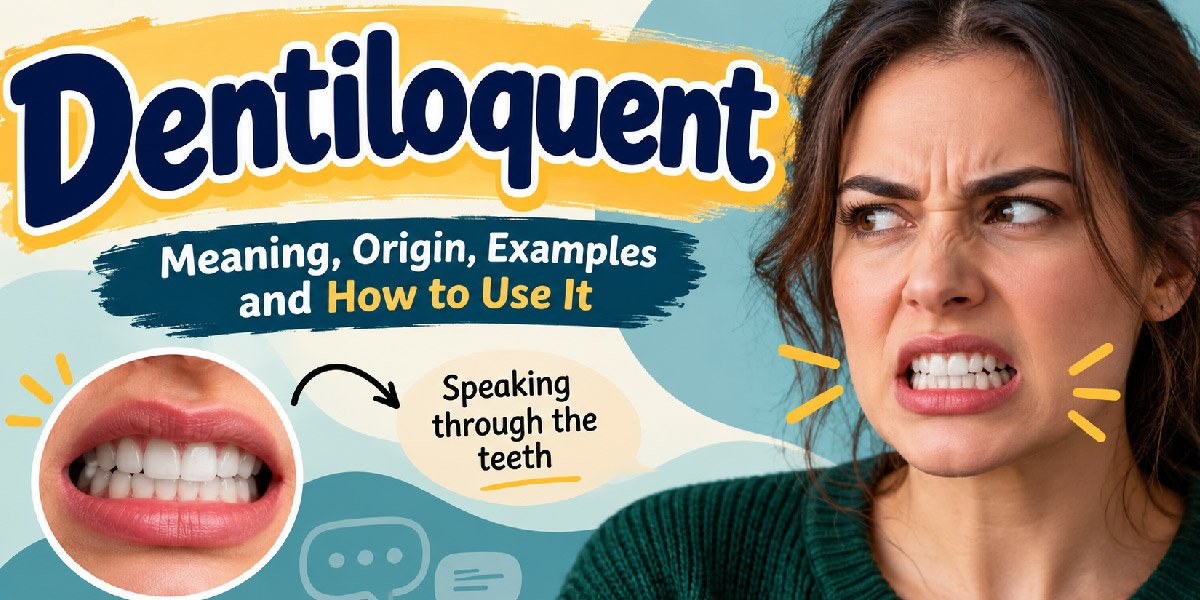
Have you ever seen someone talk without opening their mouth very much? Their teeth remain close, their jaw looks firm, and the words seem to come through a narrow space. English has an unusual word connected with this speaking style: dentiloquent.
The word may look complicated because most people never use it in everyday conversation. Its basic idea, however, is surprisingly simple. Dentiloquent means speaking through the teeth, especially when the teeth or jaw remain closely held while a person is talking.
Learning dentiloquent is also an interesting way to explore how rare English words develop. This guide explains its meaning, history, word formation, use, examples, and differences from similar terms. It also explains when this uncommon adjective can actually improve your writing.
What Does Dentiloquent Mean?
Dentiloquent is a rare adjective associated with speaking through the teeth. Imagine a person talking while keeping the teeth close and allowing only limited movement of the jaw. That physical manner of delivering words captures the basic idea behind the term.
The definition should not be made more complicated than necessary. Dentiloquent does not describe the subject being discussed or whether someone’s words are polite, rude, truthful, or dishonest. Instead, it describes how the speech is physically delivered by the speaker.
A dentiloquent response may sometimes sound tense because people can tighten their jaws when experiencing strong emotions. However, emotion is not part of the essential definition. The safest meaning to remember is simply speaking through or with closely held teeth.
Is Dentiloquent a Real English Word?
Yes, dentiloquent has historical documentation, although calling it a common modern English word would be misleading. Research on unusual English vocabulary notes that Thomas Blount included dentiloquent in his 1656 dictionary Glossographia, where it was associated with speaking through the teeth.
There is an interesting historical warning attached to such vocabulary. Linguistic scholarship has discussed dentiloquent among so-called “hothouse words”—learned-looking terms preserved by dictionaries despite having little evidence of widespread everyday use. This helps explain why the word can seem unfamiliar even to experienced English speakers.
Modern evidence also shows its unusual status. Collins has an entry for Dentiloquent in its New Word Suggestion section, defining it as “talking through one’s teeth.” Collins states that the submitted term is being monitored for evidence of usage rather than presenting it as an ordinary established headword.
Where Did the Word Dentiloquent Come From?
Dentiloquent belongs to a family of learned English formations connected with teeth and speech. The opening dent- element is familiar from words such as dental, dentist, and denture. It ultimately relates to the Latin word for a tooth.
The ending is connected with speaking. English contains several words built from speech-related Latin elements, including eloquent, loquacious, colloquy, and soliloquy. Recognizing these familiar patterns makes the strange-looking word dentiloquent much easier to understand and remember.
A simple memory method is therefore to separate the concept into two ideas: teeth + speaking. Put them together and the meaning becomes logical. Instead of memorizing a difficult dictionary definition, remember that dentiloquent describes speech produced through closely held teeth.
How Old Is the Word Dentiloquent?
Dentiloquent may appear like a modern vocabulary invention when it appears on websites or unusual-word lists, but its history reaches much further back. A scholarly discussion of rare English dictionary words identifies it in Thomas Blount’s Glossographia, published in 1656.
Its age does not mean that generations of English speakers regularly used it. In fact, its history is interesting precisely because certain elaborate dictionary words survived on paper without becoming normal everyday vocabulary. Dentiloquent appears to belong to that unusual linguistic territory.
This distinction matters when explaining the word today. It is safer to call dentiloquent a historically documented but extremely rare term rather than a popular modern adjective. Its presence in old lexicographical material gives it history, while its limited everyday use explains its unfamiliarity.
What Does Dentiloquent Speech Sound Like?
There is no single sound that every dentiloquent speaker must produce. The central feature concerns the position and movement of the mouth. When teeth remain close and jaw movement becomes restricted, normal articulation can change, making the delivery seem tighter.
Imagine a character in a dramatic scene who does not want to raise their voice. The character keeps the jaw firm, barely opens the mouth, and carefully pushes out each word. That physical delivery gives a useful picture of dentiloquent speech.
Still, the term should not be treated as a scientific diagnosis of a particular voice quality. Volume, clarity, pitch, speed, and emotion can all vary independently. A person could speak loudly or quietly while holding the teeth close; dentiloquent mainly identifies the manner of articulation.
Does Dentiloquent Always Show Anger?
No. Speaking through clenched teeth is strongly associated with anger in movies, books, and everyday body language. A frustrated person may tighten the jaw while trying to control an emotional reaction, so a dentiloquent delivery can certainly appear during an angry moment.
But describing every dentiloquent speaker as angry goes beyond the word’s basic meaning. Someone might restrict jaw movement while acting, imitating a voice, experiencing discomfort, attempting to speak discreetly, or deliberately creating an unusual sound. Context provides the emotional interpretation.
This difference is especially important for writers. Dentiloquent describes a manner of speaking, not a guaranteed emotional state. If anger matters to the scene, the surrounding words and actions should establish it instead of expecting this rare adjective to communicate the entire emotion alone.
Dentiloquent vs Mumbling
Mumbling and dentiloquent speech can both make someone’s delivery sound unusual, but the words describe different things. Mumbling generally involves speech that is too quiet or unclear for listeners to understand easily. Clenched or closely held teeth are not required.
Dentiloquent is more physically specific. It points toward speaking through the teeth or with them held closely together. A speaker could theoretically pronounce every word clearly while doing this, meaning that dentiloquent speech does not automatically qualify as mumbling.
This distinction provides a useful writing rule. If the important detail is that listeners cannot clearly hear the words, mumbling may be appropriate. If the important image is a tight jaw and speech passing through closely held teeth, dentiloquent expresses the more specific idea.
Dentiloquent vs Muttering
Muttering normally refers to speaking in a low or indistinct manner, sometimes because the speaker does not want other people to hear clearly. People may also mutter complaints to themselves. The word therefore often tells us something about volume or clarity.
Dentiloquent focuses on a different feature. The speaker’s teeth and jaw position are central to the image. The person does not necessarily need to speak softly. A sentence spoken through tight teeth could still be loud enough for everyone nearby to hear.
Someone could even mutter while speaking through their teeth, meaning both descriptions could sometimes apply to the same moment. They remain separate concepts, however. Muttering concerns a low or indistinct delivery, while dentiloquent identifies speech formed through closely held teeth.
Dentiloquent vs Eloquent
These two words look somewhat related on the page, but their meanings should never be confused. Eloquent commonly describes speech or writing that expresses ideas effectively, clearly, or persuasively. It is concerned with the quality and power of expression.
Dentiloquent describes a physical manner of speech instead. It does not tell us whether someone’s argument is intelligent, beautiful, convincing, or poorly expressed. A brilliant speaker could theoretically give an eloquent statement while keeping the teeth closely held.
The contrast is useful for remembering both words. Think of eloquent as describing how effectively ideas are expressed and dentiloquent as describing a particular physical way speech is produced. Their similar appearance does not make them synonyms or interchangeable adjectives.
Is Dentiloquent a Medical or Speech Disorder?
Dentiloquent should not be used as the name of a medical condition simply because it describes an unusual way of talking. Historical and modern definitions focus on speech through the teeth; they do not establish dentiloquent as a clinical diagnosis.
This distinction prevents unnecessary confusion. Speech can change for many reasons, including habits, deliberate performance, dental factors, jaw movement, injury, and medical conditions. A rare vocabulary term cannot tell you why a particular person’s speech sounds different or whether treatment is needed.
Therefore, use dentiloquent descriptively rather than diagnostically. If someone has persistent difficulty moving the jaw, speaking clearly, or using the mouth normally, that situation requires appropriate professional assessment. The vocabulary word itself cannot identify the underlying cause of those difficulties.
How to Use Dentiloquent in a Sentence
Because dentiloquent functions as an adjective, it can describe a reply, voice, remark, response, delivery, or speaking style. For example: “His dentiloquent reply made the friendly conversation suddenly feel tense.” The surrounding context helps unfamiliar readers understand the meaning.
Another example would be: “The actor used a dentiloquent delivery to make the character appear controlled during the argument.” You could also write: “She gave a dentiloquent warning, keeping her teeth close together as she spoke.” Both sentences make the physical action clear.
Context is particularly important because dentiloquent is so rare. Simply writing “He was dentiloquent” may leave many readers confused. Adding a clue about the jaw, teeth, or manner of speaking lets readers understand the sentence without interrupting their reading to search for a definition.
When Should Writers Use Dentiloquent?
Dentiloquent works best when a writer intentionally wants an unusual and precise vocabulary choice. Fiction is an obvious setting. A novelist might use it to describe a character whose tight jaw or restricted mouth movement contributes something meaningful to a tense scene.
It can also fit articles about language, vocabulary challenges, historical dictionaries, word games, and unusual English expressions. In those settings, unfamiliarity is actually part of the attraction because readers are there specifically to discover words they probably do not encounter every day.
For general communication, however, simpler wording is normally better. “Speaking through clenched teeth” immediately creates the intended picture for most readers. Good vocabulary is not about choosing the rarest possible term; it is about choosing the clearest word for the audience and purpose.
Why Is Dentiloquent So Uncommon Today?
One reason is simple: English already has familiar phrases that communicate the idea clearly. “Speaking through clenched teeth” requires several words, but almost every English reader immediately understands the image. Dentiloquent may require an explanation before it becomes useful.
Its history may also help explain its rarity. Scholarship discussing early lexicography identifies dentiloquent among elaborate “hothouse words,” a label applied to certain unusual dictionary terms whose actual life in ordinary English may have been extremely limited.
That makes the word linguistically fascinating. Dentiloquent demonstrates that appearing in a dictionary does not automatically make a term common. Vocabulary survives in different ways: some words enter daily conversation, while others remain largely in dictionaries, specialist discussions, historical records, quizzes, and collections of unusual English.
Common Mistakes When Using Dentiloquent
The first mistake is treating dentiloquent as another word for angry. Anger can cause someone to speak through clenched teeth, but it is an interpretation supplied by context. The adjective itself primarily describes the physical manner in which speech is produced.
Another mistake is confusing it with mumbling, whispering, or muttering. These actions may occur alongside restricted jaw movement, but none is automatically dentiloquent. A person can whisper with relaxed teeth, mumble with an open mouth, or speak clearly while keeping the jaw tight.
Finally, writers should avoid presenting dentiloquent as everyday vocabulary. Its rarity is an important part of an accurate explanation. Calling it common would give readers the wrong impression. Use it knowingly, and provide enough context whenever your intended audience may not recognize it.
Final Thoughts
Dentiloquent is a rare adjective meaning speaking through the teeth. Although the term is unfamiliar to most modern speakers, historical scholarship traces it to at least Thomas Blount’s 1656 Glossographia. Its long history makes it more than a recent internet vocabulary trend.
The word describes how speech is delivered, not automatically why someone speaks that way. Anger and tension may accompany tightly held teeth, but they are contextual clues rather than fixed parts of the definition. Dentiloquent should also not be mistaken for mumbling or a medical diagnosis.
For everyday communication, “speaking through clenched teeth” will usually be clearer. For fiction, vocabulary study, language articles, or discussions of rare English, dentiloquent offers something different: one compact and memorable word for a surprisingly specific way of speaking.
(FAQs)
What does dentiloquent mean?
Dentiloquent means speaking through the teeth or describing speech produced while the teeth are held closely together. It is an extremely rare adjective and is not commonly heard in normal modern conversation.
Is dentiloquent a real word?
Dentiloquent is historically documented. Research discussing unusual English dictionary words notes its appearance in Thomas Blount’s Glossographia from 1656. However, its actual everyday usage has historically been very limited.
Does dentiloquent mean speaking angrily?
Not necessarily. A person may speak through clenched teeth when angry, but dentiloquent mainly describes the physical manner of speech. The speaker’s emotion must be understood from the surrounding situation.
What is the difference between dentiloquent and mumbling?
Dentiloquent refers specifically to speaking through or with closely held teeth. Mumbling describes speech that is generally quiet or difficult to understand. Someone can therefore speak through their teeth without necessarily mumbling.
Is dentiloquent commonly used today?
No. It is an exceptionally uncommon term. Collins currently places Dentiloquent in its New Word Suggestion section and says it is being monitored for evidence of usage, rather than treating it like an ordinary everyday dictionary headword.
How can I remember the meaning of dentiloquent?
Connect the beginning dent- with teeth, as in dental and dentist, and associate the rest of the word with speaking. The simple idea to remember is teeth + speech = speaking through the teeth.









Discussion about this post